


Beginner’s Guide to Choosing the Right Bass Drum Pedal | Graham Russell Drums
- Posted on
- By Alex
- Posted in Bass Drum Pedals
- 0
A simple beginner’s guide to choosing a comfortable, reliable single bass drum pedal: Real world advice from the team at Graham Russell Drums
Last updated: 21 August 2026
Choosing a first bass drum pedal can feel more complicated than it needs to be. Pedal descriptions often mention single-chain and double-chain drives, cams, footboards and adjustment systems, but beginners do not need to prioritise every technical feature at once.
A useful starting point is to compare how each pedal is designed, which adjustments it provides and whether its size and layout suit the way you will use it. This beginner’s bass drum pedal guide focuses on affordable single bass drum pedals, using seven models from SONOR, Yamaha, TAMA and Pearl as practical examples rather than attempting to catalogue every pedal available.
The pedals in this guide have been selected from models we stock, set up and compare with customers at Graham Russell Drums, with technical specifications checked against current manufacturer information.
Quick Answer: Which Beginner Bass Drum Pedal Should You Choose?
For most beginners, our all-round recommendation is the TAMA Iron Cobra HP200P because it combines a straightforward single-chain design with a responsive Power Glide cam and enough adjustment to remain useful as your technique develops. Choose the TAMA HP50 The Classic if compact transport matters most, or look at the TAMA Speed Cobra HP310L and Pearl P-930 Demonator if you specifically want a longer footboard.
What Should You Look for in a Beginner Bass Drum Pedal?
At Graham Russell Drums, we recommend looking beyond chain count or one headline feature. The selected models differ in their drive systems, footboard designs, cam profiles, adjustment mechanisms and transport features, so the most useful feature will depend on the individual player.
The main points worth considering are:
- Drive system: the mechanism connecting the footboard movement to the beater assembly.
- Footboard design: whether the pedal uses a conventional or extended board.
- Cam design: whether the pedal provides one fixed response or a choice of cam profiles.
- Adjustment: the available controls for spring tension, beater angle and other settings.
- Transport: whether the pedal has a compact or folding design.
These features describe how a pedal is constructed, but they do not create a universal ranking. The most suitable beginner bass drum pedal is the design that feels manageable and suits how often it will be transported, adjusted and played.
Single-Chain vs Double-Chain Bass Drum Pedals
A single-chain bass drum pedal uses one chain to transfer footboard movement to the drive sprocket or cam. A double-chain pedal uses two parallel chains. This difference is easy to compare visually, but chain count alone does not determine the complete response of a pedal.
Footboard length, cam or sprocket shape, hinge design, spring setting and overall geometry also affect the action. It is therefore more useful to compare the complete pedal than to assume that two chains automatically make a pedal better for a beginner.
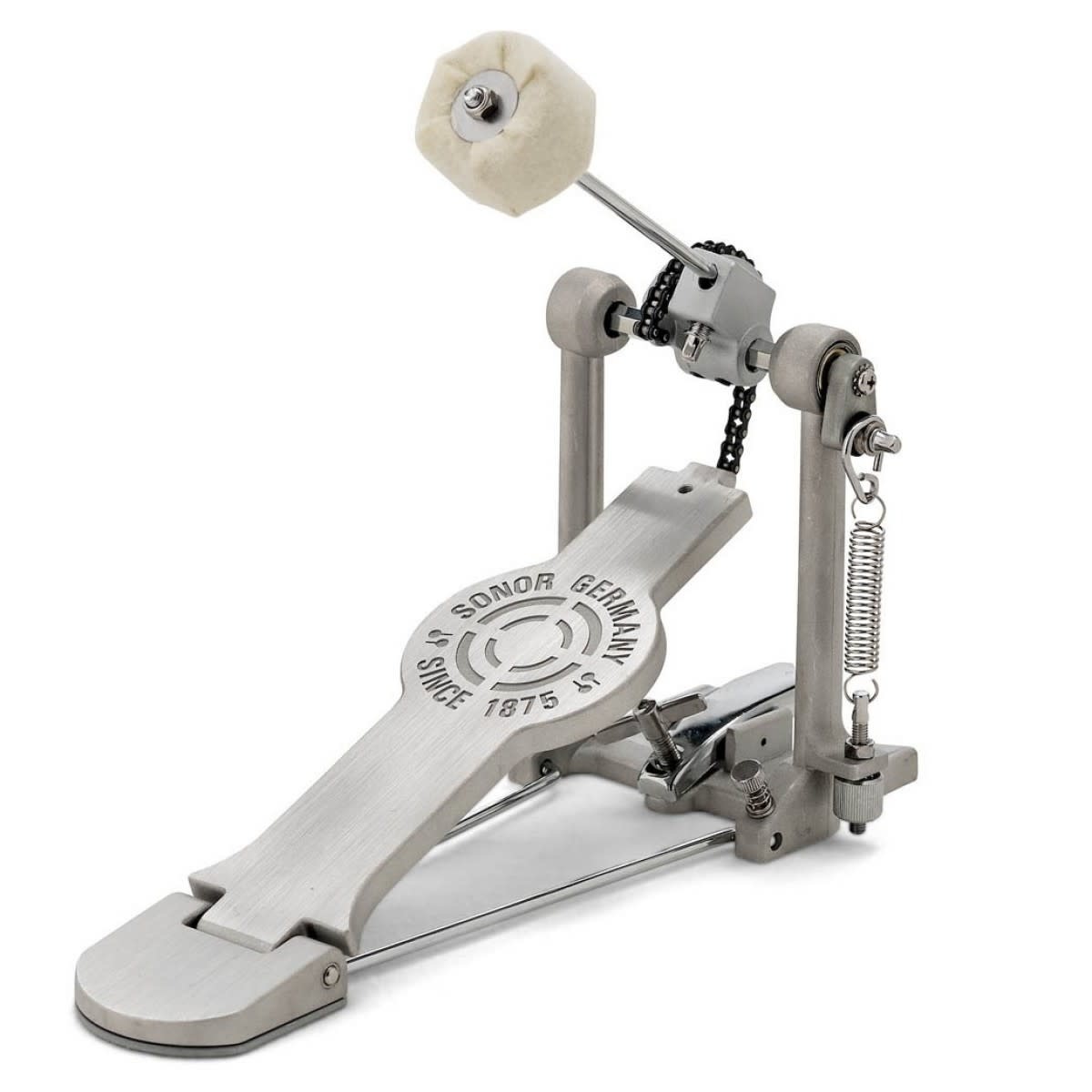
The SONOR SP 1000 is a useful place to start. It sits within SONOR’s 1000 Series, which is designed for beginners and players looking for dependable, straightforward hardware. The SP 1000 uses a single-chain drive and gives you spring-tension adjustment, with the footboard height moving together with the beater angle.
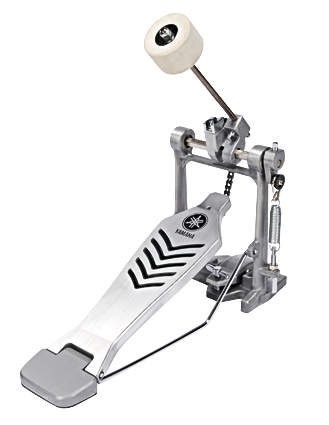
The Yamaha FP7210A is another straightforward option. It uses a single-chain drive designed to provide uniform action with a natural feel. You can also adjust the beater and footboard angle together.
Longboard Bass Drum Pedals, Cams and Pedal Response
A longboard bass drum pedal uses an extended footboard, providing more playing surface for different foot positions. The TAMA Speed Cobra HP310L and Pearl P-930 are both longboard examples, but their chain and cam systems are different.
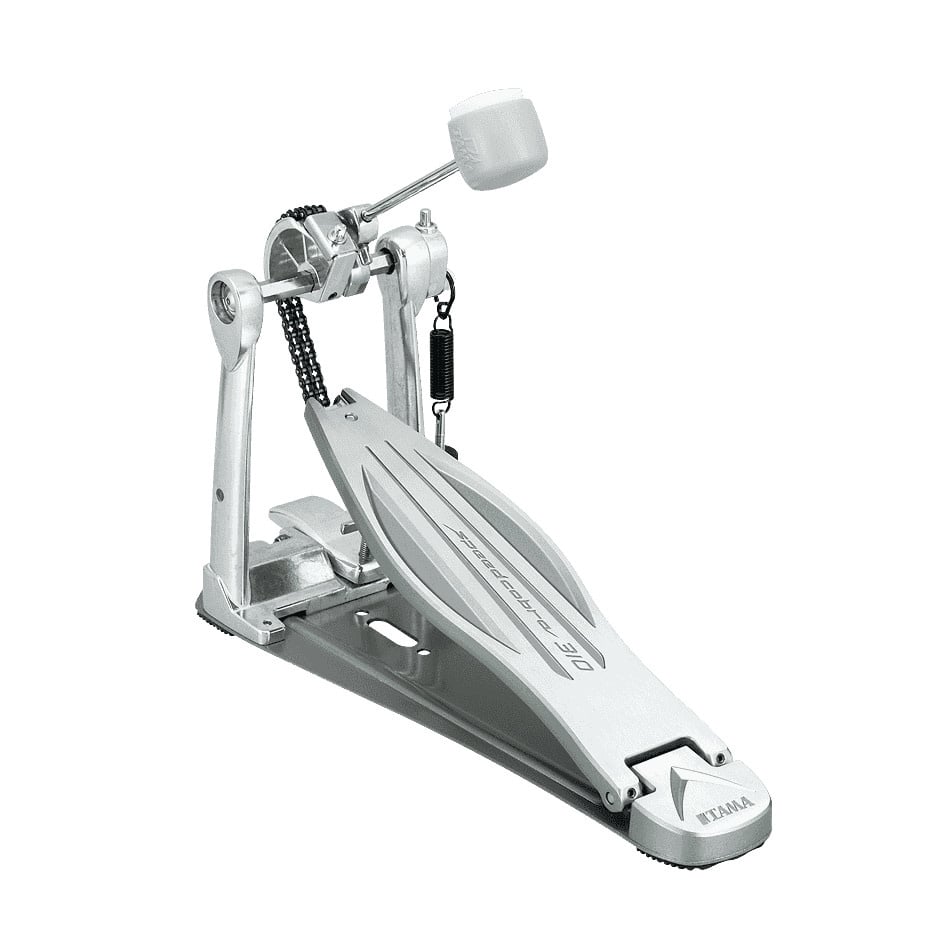
Footboard length is one of the clearest visual differences between pedals. The Speed Cobra HP310L has a longer footboard than TAMA’s Iron Cobra pedals. This extended design is intended to increase beater acceleration and power while requiring less physical effort.
The TAMA Speed Cobra HP310L also uses TAMA’s Recessed Setting. This combines the natural motion of a chain-drive pedal with the lighter overall action associated with the Speed Cobra 310 design.
Its drive uses a true-round LiteSprocket rather than a Power Glide cam. The LiteSprocket is designed to provide natural, smooth action while keeping the sprocket weight down. The pedal also has a double-chain drive, linked beater and footboard angle adjustment, and adjustable spring tension.
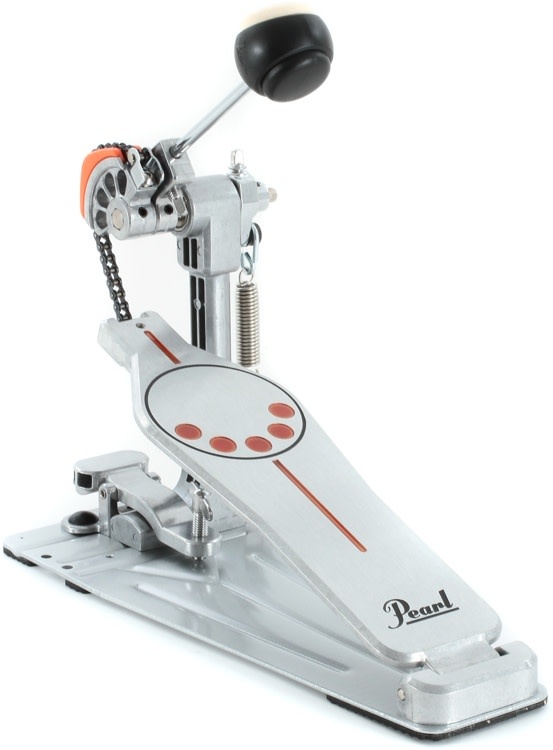
The Pearl P-930 Demonator shows that a longboard does not have to use a double-chain drive. It combines a single-chain drive with a Demon-style longboard and two cam options: the Perfect Circle cam and a removable Orange Eccentric Cam for a more accelerated stroke.
You also get a two-position PowerShifter, Click-Lock spring-tension adjustment, an infinitely adjustable beater angle and a Control Core DuoBeater. Moving the PowerShifter changes the footboard leverage, giving you another way to alter the pedal feel.
The TAMA Iron Cobra HP600D takes a different approach. Its reversible Duo Glide cam lets you switch between two profiles. Rolling Glide provides a smooth, consistent response throughout the stroke, while Power Glide is designed to increase power and speed as the stroke develops.
The HP600D also uses a double-chain drive, a ball-bearing Speedo-Ring and TAMA’s Para-Clamp. The rotating head of the Para-Clamp follows the angle of the bass drum hoop so the pedal can remain flat on the floor.

How to Adjust a Bass Drum Pedal
Most beginner pedals arrive in a playable standard setup. Adjustments are there to fine-tune the response rather than create one universally correct setting.
Spring Tension
Spring tension changes the resistance beneath the foot and the return of the mechanism. The SONOR SP 1000, TAMA Speed Cobra HP310L, TAMA Iron Cobra HP600D, TAMA Classic and Pearl P-930 all include spring adjustment, although the exact mechanism differs between models. Small changes are easier for a beginner to evaluate than moving an adjuster immediately to either extreme.
Beater and Footboard Angles
Beater-angle adjustment changes the beater’s starting position, while footboard-angle adjustment changes the resting position beneath your foot. On the Yamaha FP7210A, the beater and footboard angles move together. The Speed Cobra HP310L also links these settings, while the TAMA Classic lets you adjust them independently. The Pearl P-930 gives you an infinitely adjustable beater angle.
Cam and Footboard-Position Options
Cam profiles provide another way to alter pedal response. The Iron Cobra HP600D switches between Rolling Glide and Power Glide by reversing its Duo Glide cam. The Pearl P-930 changes between a Perfect Circle cam and removable Orange Eccentric Cam, while its PowerShifter changes footboard leverage and feel.
Beginners do not need every available adjustment, but clearly labelled options can be useful as technique develops. It is sensible to change one setting at a time, play the pedal for a while and keep the setup that feels easiest to control.
- Attach the pedal squarely and securely to the bass drum hoop.
- Begin with spring tension around the middle of the available range.
- Use a moderate beater angle rather than an extreme starting position.
- Change one setting at a time and play for several minutes before judging the result.
Once your pedal is set up, you can also explore our bass drum pedal accessories, including replacement beaters, pedal bags, practice pads and useful pedal components.
Hoop Clamps and Setup
The clamp is the part that secures the pedal to the bass drum hoop. The Iron Cobra HP600D uses TAMA’s rotating Para-Clamp head. The TAMA Classic places its Easy-Tight Hoop Clamp screw on the outside of the frame so it can be reached easily during setup and removal.
Portability and Compact Storage
The TAMA HP50 The Classic is a useful alternative when compact storage matters. You can fold it into a compact right-angle triangle by tilting the spring post towards you.
View the TAMA HP50 The Classic Pedal at Graham Russell Drums
The Classic also includes a height-adjustable frame intended to help position the beater at the centre of different bass drum sizes, top-mounted spring adjustment, independent beater and footboard-angle adjustment, and an Easy-Tight Hoop Clamp.
For more transport-focused options, read our Lightweight Drum Hardware Guide.
Our GRD Recommendation: TAMA Iron Cobra 200
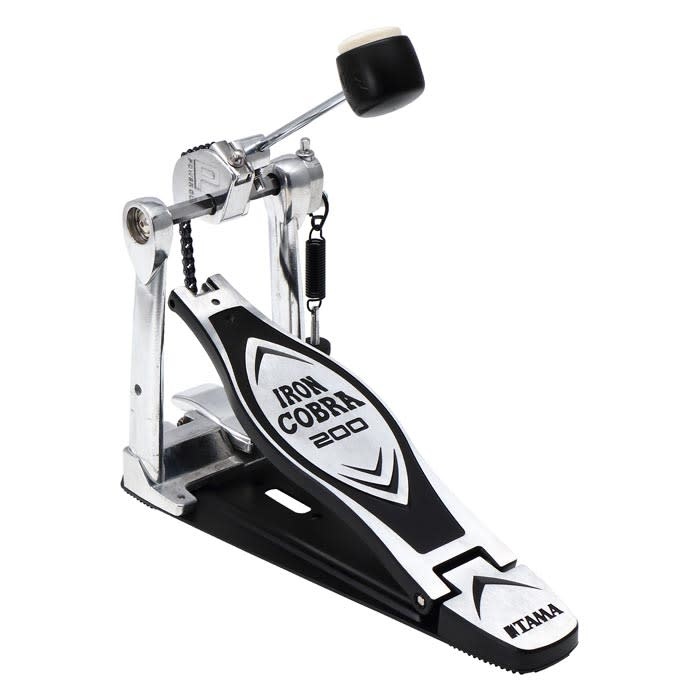
After comparing the affordable pedals in this guide, our pick for most beginners is the TAMA Iron Cobra HP200P. In our view, it strikes the best balance between a straightforward setup, a responsive feel and enough performance for a player to keep using as their technique develops.
The HP200P is a single-chain pedal with TAMA’s Power Glide offset cam—the same cam shape used by the Iron Cobra 900 Power Glide series. This gives you a light, smooth action while increasing leverage through the stroke. Its Spring Tight tension rod is designed to prevent the spring from twisting, helping the mechanism transfer power consistently.
What makes it such a strong first pedal for us is that it offers a recognisable Iron Cobra response without surrounding a beginner with unnecessary controls. It sits above the most basic entry-level designs, but it remains easy to understand and adjust. You can also add TAMA’s Cobra Coil later should you want a faster footboard return.
Best suited to: beginners who want a dependable all-round pedal with a clear step up from a basic starter model.
Choosing a Beginner Bass Drum Pedal for Lessons, Practice and Rehearsals
A first beginner bass drum pedal should suit the way it will actually be used. Someone carrying hardware to lessons every week may value a compact design, while a pedal that remains attached to a home kit does not need to prioritise packed size.
For a Simple First Pedal
The SONOR SP 1000 and Yamaha FP7210A provide clearly specified single-chain starting points. Both keep the main feature list relatively focused, while still allowing key adjustments to be made.
For Compact Transport
The folding mechanism is the defining reason to consider the TAMA Classic. Its frame can be folded into a compact triangular shape, and its height adjustment is designed to help centre the beater on different bass drum sizes.
For a Longer Footboard
The TAMA Speed Cobra HP310L and Pearl P-930 both use extended footboards, but their drive and adjustment systems differ. The Speed Cobra combines a double chain with TAMA’s Recessed Setting and true-round LiteSprocket. The Pearl combines a single chain with interchangeable cams and PowerShifter adjustment.
For More Cam Choice
The Pearl P-930 and TAMA Iron Cobra HP600D are the strongest examples here when experimenting with cam response is a priority. The Pearl uses a removable eccentric cam over its Perfect Circle cam, while the TAMA switches between two sides of its Duo Glide cam.
What Should You Pay For in a Beginner Bass Drum Pedal?
For a beginner, it makes more sense to pay for features you will actually use than to chase a particular price point. Prices and promotions can change, so this guide does not use fixed bands; instead, focus on the pedal features that solve a practical need or make the setup easier to control.
A player seeking a simple single-chain design may consider the SONOR SP 1000 or Yamaha FP7210A. Our all-round recommendation, the TAMA Iron Cobra HP200P, adds a Power Glide cam and Spring Tight mechanism while remaining easy to understand. The TAMA Classic adds compact folding, the Speed Cobra HP310L introduces an extended footboard and Recessed Setting, the Pearl P-930 combines a longboard with interchangeable cams, and the Iron Cobra HP600D provides a reversible Duo Glide cam.
More features do not automatically make one pedal the right choice for every beginner. It is worth paying for an adjustment or design feature when it solves a practical need or creates the response you prefer.
Beginner Single Bass Drum Pedals Compared
These seven pedals cover a useful range of beginner-friendly designs. The table is a starting point rather than a strict ranking, with our main recommendation highlighted separately above.
On a phone or small tablet, swipe horizontally across the table to view every column.
| Pedal | Drive or design | Key feature | Worth considering when… |
|---|---|---|---|
| SONOR SP 1000 | Single-chain drive | Spring tension and linked footboard-height/beater-angle adjustment | You want a clearly beginner-focused starting point |
| Yamaha FP7210A | Single-chain drive | Uniform-action design and linked beater-angle adjustment | You want a straightforward traditional chain pedal |
| TAMA Iron Cobra HP200P | Single chain with Power Glide cam | Spring Tight mechanism and optional Cobra Coil compatibility | Our GRD all-round recommendation for most beginners |
| TAMA HP50 The Classic | Compact folding pedal design | Folding frame, centre-strike height adjustment and independent angles | Compact storage and flexible positioning matter |
| TAMA Speed Cobra HP310L | Double chain with true-round LiteSprocket | Extended footboard and Recessed Setting | You prefer a longer board and TAMA’s lighter-action design |
| Pearl P-930 Demonator | Single chain with interchangeable cams | Longboard, PowerShifter and Click-Lock spring adjustment | You want several setup options in a single-chain pedal |
| TAMA Iron Cobra HP600D | Double chain with Duo Glide cam | Switchable Rolling Glide and Power Glide profiles | You want two clearly documented cam responses |
Try Bass Drum Pedals Before Buying
Specifications are helpful, but they cannot tell you exactly how a pedal will feel beneath your foot. Trying more than one design lets you compare footboard position, adjustment range and overall action for yourself.
Our experienced team of working drummers sets up, demonstrates and compares pedals for customers in the shop. We can talk you through the differences, help with the initial setup and let you compare available models on a bass drum at our Fareham store.
For more brand-specific information, read our Ultimate Guide to Yamaha Bass Drum Pedals and Ultimate Guide to TAMA Bass Drum Pedals.
Check the location shown on the individual product page or contact us before travelling to try a particular pedal.
Frequently Asked Questions
Is a single-chain or double-chain bass drum pedal better for beginners?
Neither is automatically better. Single-chain pedals use one chain and double-chain pedals use two, but the cam, footboard, hinge, spring setting and overall geometry also affect the response. Choose the complete pedal that feels easiest to control.
What is a longboard bass drum pedal?
A longboard pedal uses an extended footboard that provides more playing surface for different foot positions. The TAMA Speed Cobra HP310L and Pearl P-930 are both longboard pedals, although one uses a double-chain drive and the other uses a single-chain drive.
What does bass drum pedal spring tension do?
Spring tension changes the resistance beneath the foot and the return of the pedal mechanism. Begin around the middle of the adjustment range, make small changes and keep the setting that feels easiest to control consistently.
What is the difference between the TAMA Speed Cobra HP310L and Iron Cobra HP600D?
The Speed Cobra HP310L uses an extended footboard, Recessed Setting and true-round LiteSprocket. The Iron Cobra HP600D uses a conventional-length footboard and a reversible Duo Glide cam that switches between Rolling Glide and Power Glide.
Can the TAMA Classic bass drum pedal be folded?
Yes. TAMA states that the spring post can be tilted so the HP50 Classic folds into a compact right-angle triangle for storage in a pedal bag.
Does a beginner need an interchangeable cam?
No. An interchangeable or reversible cam gives the player another way to alter pedal response, but a fixed-cam pedal can still be an excellent first choice when its standard action feels comfortable.
Should a beginner buy a single or double bass drum pedal?
A single pedal is the simplest starting point for most beginners and is suitable for the majority of common bass drum techniques. Players who specifically want to develop two-foot bass drum patterns can also browse our double bass drum pedals.
Should a beginner choose a bass drum pedal from specifications alone?
No. Specifications help you identify features, but pedal feel is personal. Our general starting recommendation is the TAMA Iron Cobra HP200P, although trying several pedals remains the best way to decide whether another footboard, cam or transport feature suits you better.
Final Thoughts
The safest way to compare beginner bass drum pedals is to separate verified design features from assumptions about how every player will experience them. Based on the pedals we sell, set up and compare with customers at Graham Russell Drums, the TAMA Iron Cobra HP200P is our strongest all-round recommendation for most beginners. The other models remain worthwhile when a specific feature—such as compact folding, a longboard or additional cam adjustment—matters more to you.
Use those differences to create a shortlist, then compare the pedals in person where possible. Comfort, setup and intended use should complete the decision.
Technical specifications in this guide were checked against current official information from SONOR, Yamaha, TAMA and Pearl. The GRD recommendation reflects our practical experience selling, setting up and comparing pedals with customers. Product availability and pricing should be confirmed on the live Graham Russell Drums product pages.
Still building your first setup? Explore the GRD Drum Buyer’s Guide for more practical advice on drum kits, cymbals, hardware, practice equipment and accessories.
Browse Single Bass Drum Pedals at Graham Russell Drums
Written by Alex Neave
I've been part of the Graham Russell Drums team since October 2025, but my connection with the shop goes back much further as a customer since 2012. I've advised drummers of all ages and experience levels, worked on a wide range of second-hand kits and spent a lot of time helping customers navigate the often overwhelming world of drum gear. Alongside over 13 years of playing experience, that hands-on exposure to a wide range of products allows me to write buying guides based on real-world knowledge and practical experience rather than simply repeating manufacturer specifications.












Comments
Be the first to comment...