


Buying Your First Drum Kit
Start Here
How to choose your first drum kit
Kits are listed by shell sizes, some come with cymbals and some do not, and nobody tells you that a beginner drum kit usually needs a stool and a pair of sticks on top. This page sorts all of that out.
We are Graham Russell Drums in Fareham, the largest supplier of beginners drum kits anywhere in the UK. Whether it is a first drum kit for a child, a quiet drum kit for a flat or a full size drum set for beginners, you do not need to know anything about drums to use this page.
The Quick Answer
Got the space? Buy an acoustic kit. It feels and sounds like the real thing from day one, which is what keeps a beginner practising.
In a flat, or practising in the evening? Buy an electronic kit. Headphones in, nobody else hears it.
Finance and the Assisted Instrument Purchase Scheme are both available on the kits on this page.
Acoustic or electronic?
Neither one is the beginner option and neither is a wrong answer. These are some of the reasons people go each way, but every situation is different, so treat them as a steer rather than a rule.
Option One
Why people go acoustic
-
There is a garage, a spare room, a loft or a corner to give over to it.
-
You want the real feel and the real sound, which is what makes people fall in love with drumming.
-
The kit needs to work at a school, a band practice or a gig later on.
Option Two
Why people go electronic
-
Neighbours are close by, or home is a flat or a terrace.
-
Practice is going to happen in the evening, after school or after work.
-
Space is tight, and built-in coaching and headphone practice appeal.
Plenty of drummers end up with one of each. If none of that settles it, ring us on 01329 834012 and talk it through.
What is actually in the box
A drum kit, or drum set, is four separate things sold as one. This is where first-time buyers get caught out online, because plenty of kits elsewhere are sold as drums only. Not every kit includes everything, and where one does not we say so on the kit itself. A shell pack means the drums alone, so it will always need a stool and sticks adding.
-
The drums. Usually five: a bass drum played with a foot pedal, a snare in front of you, two small toms above it and a larger floor tom to your right.
-
The hardware. The metal stands and pedals that hold it all up. Nothing works without them, and they are often sold separately elsewhere.
-
The cymbals. The brass ones. A pair of hi-hats worked by a foot pedal, a crash for accents, and on most packages a ride cymbal too.
-
Sticks and a stool. Needed on any kit that does not list them, and on every shell pack. Ask for a pair of 5A sticks: that is the standard size and where almost every drummer starts. Add headphones for an electronic kit. Tell us and we will pack the right ones with the kit, or pick your own from drum sticks and drum stools.
Four beginner acoustic kits we recommend
These are the complete acoustic beginner drum kits we put families and new drummers on most often, and any of the four works as a starter drum kit for kids and adults alike. All four come with cymbals and hardware included, so they are ready to play once built. Each one comes in several colours, so click through and look at the related products on the kit’s own page to see the full range. Every button goes straight to that kit for the current price and stock.
Should I get a 20″ or a 22″?
It is a choice of sound, not of size. The number is the width of the bass drum, the one played with the foot. A 20″ technically takes up less floor, but the difference is negligible: the stands take up most of the room either way, and the depth is the same.
So it comes down to sound. A 22″ sits lower with a deeper thud. A 20″ is a fully capable drum kit with a tighter voice. A young player can absolutely handle a 22″, and may well grow into wanting a 16″ floor tom later on.
Both are middle ground rather than big or small, and they are the same sizes used on full adult professional and intermediate kits. That matters more than it sounds when you are learning, because moving between a school kit, a teacher’s kit and your own then feels the same.
If you are torn, ring us on 01329 834012.
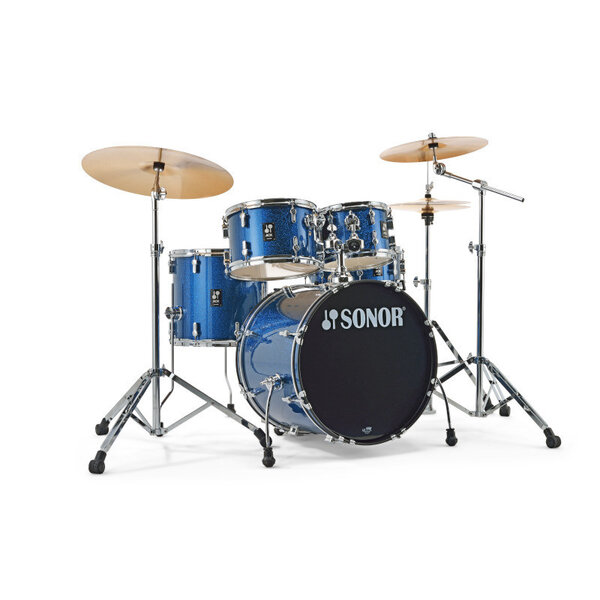

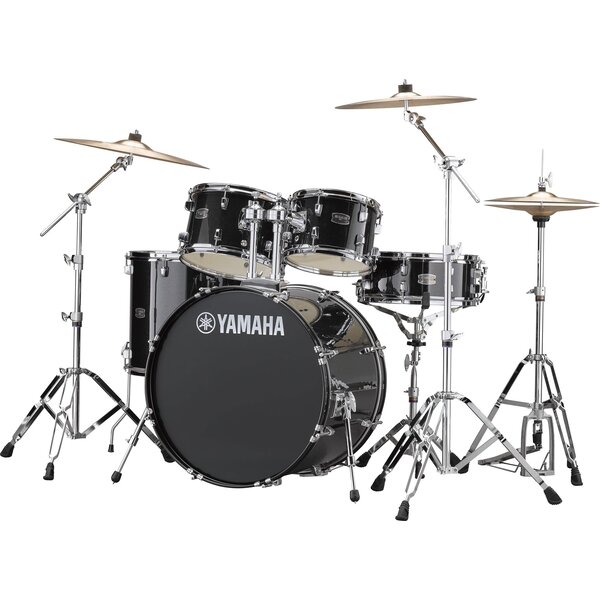

Not sure which size, or which of the four? Ring us on 01329 834012 and we will tell you.
See Every Beginner Kit And Price
Four beginner electronic kits we recommend
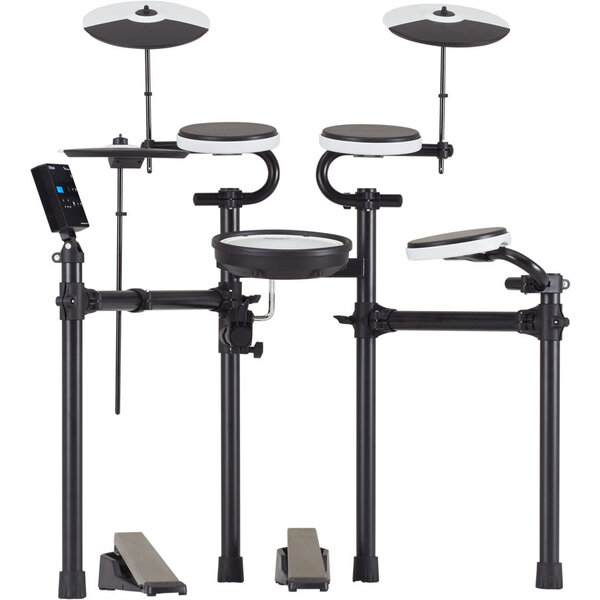
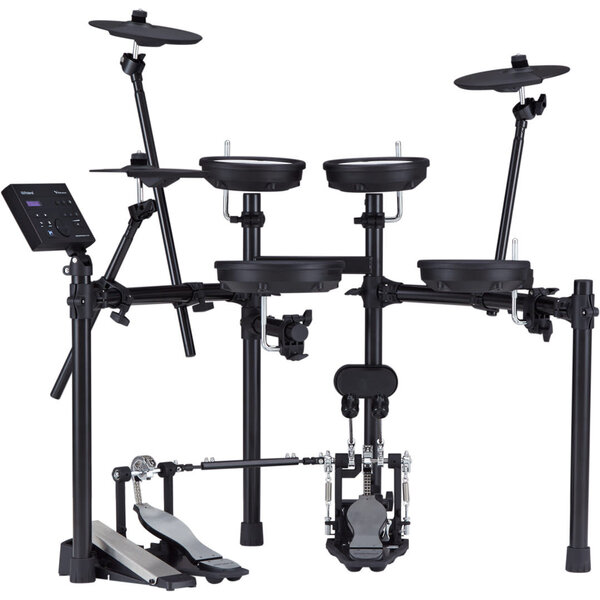
A beginner electronic drum kit, or electric drum kit as most people call it, plugs into headphones, takes up a fraction of the space and can be played late in the evening. These four are the ones we point beginners at, from Yamaha and Roland. The differences that matter are the kick pedal and whether the pads are rubber or mesh.
Rubber pads or mesh heads?
Rubber is perfectly acceptable for learning technique and coordination. It is just a touch bouncier than a real drum head. Mesh is a woven fabric that gives under the stick, so it feels closer to a real drum and is quieter in the room.
Whichever you land on, we always recommend stretching to an electronic kit with a mechanical bass drum pedal if you possibly can. Learning the right foot on a real pedal makes everything that comes after it easier.
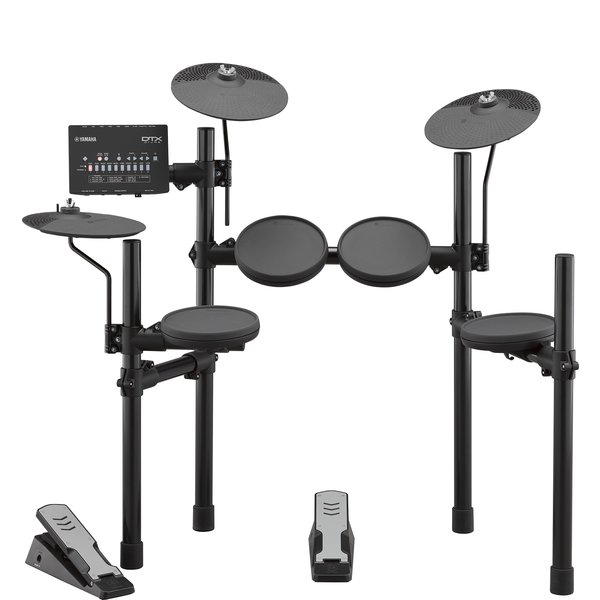
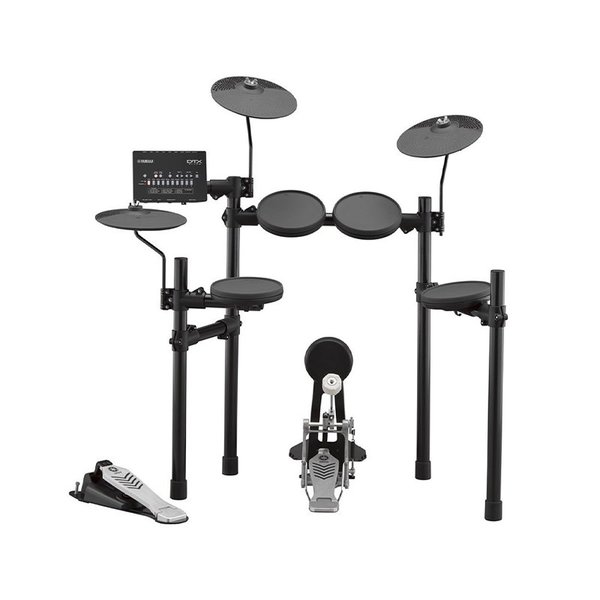
See Every Electronic Kit And Price
Paying for it and getting it home
Spread the cost
Finance is available on every kit on this page, so you can pay monthly rather than all at once.
Learning at school?
Every kit on this page is available through the Assisted Instrument Purchase Scheme, which can make a first instrument significantly cheaper for families.
Delivery and returns
Delivery timescales, returns and warranty cover, all explained in one place.
The questions we get asked every week
These come up on the phone constantly, usually from people apologising for not knowing. Please do not apologise. Nobody is born knowing this.
Is a drum set the same as a drum kit?
Yes. Two names for the same thing. Drum kit is what we say in the UK, drum set is the American term, and you will see both on listings and in lessons online. Nobody is going to correct you either way.
A starter drum kit and a beginner drum set are likewise the same purchase: the drums, the stands and pedals that hold them up, and usually the cymbals, sold together as one package.
How much should I spend on a first drum kit?
Enough to get a complete package rather than a bare shell pack. The very cheapest kits online tend to have thin shells, cymbals that sound like bin lids and hardware that wobbles, and a beginner ends up blaming themselves for the sound rather than the kit.
Every kit on this page is one we would happily put a beginner on. Tap through for the current price, or ring us with a budget and we will tell you what it reaches.
Are drums too loud for a normal house?
In a house with a bit of space around it, an acoustic kit is very manageable, and low-volume cymbals and mesh heads bring it down further if you want them. In a flat or a terrace, an electronic kit with headphones solves it completely.
Our Acoustic vs Electronic read goes through noise in detail.
What is the difference between an electric and an electronic drum kit?
Nothing at all. Most people say electric drum kit, the trade says electronic, and they mean the same instrument: rubber or mesh pads in place of drums, a module that makes the sound, and a headphone socket so only the player hears it.
The four on this page are all from Yamaha and Roland, the two brands we trust most at this end of the market.
What age can a child start on drums?
If they can reach the pedals, they are fine. Beyond that, the earlier anyone starts the better. Eric Moore started drumming at four.
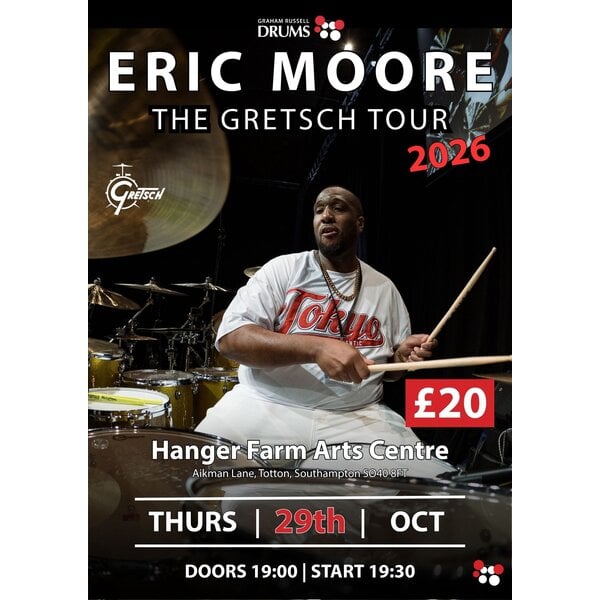
We host drummers like him at the shop all the time. Read about his career and the Gretsch and Paiste gear he plays, and see who else we have had in.
How much room does a drum kit take up?
Less than people picture, but more than a corner. For a full size acoustic kit, plan on a square of floor roughly one and a half metres each way once the player is sat behind it, plus a bit of height for the cymbal stands.
A beginner electronic kit folds down considerably smaller and will fit along a bedroom wall.
What else do I need to buy on top of the kit?
Sticks. Ask for a pair of 5A. That is the standard size and where almost every drummer starts, and a Vic Firth American Classic 5A is the pair we hand over most often.
A drum stool. Needed on any kit that does not include one, and on every shell pack. Get a height-adjustable one so it keeps working as the player grows, and so they can sit at the right height rather than whatever a dining chair happens to be.
Headphones for an electronic kit, and on the Roland TD-07DMK a bass drum pedal as well. Tell us and we will pack the lot with the kit.
After that, a practice pad is the single best thing anyone can add, because most real progress happens quietly on a pad rather than on the kit.
Will they grow out of a beginner kit?
A decent beginner kit is not a stepping stone you throw away. Plenty of the drummers who come into the shop are still using the hardware and cymbals from their first package years later, and plenty are still playing the kit itself.
If the day does come when they want something better, we take kits in part exchange, so the first one puts money towards the next.
Can we come and try one before we buy?
Yes, and it is the best thing you can do. We are at Unit 5 Axis Park, Newgate Lane, Fareham PO14 1FD, open Monday to Saturday, 9am to 5pm. Every kit on this page can be played before you decide.
Three reads worth ten minutes before you buy
Written by the people who sell these kits every day, not by a marketing department.
Start With This One
Acoustic vs Electronic Drums for Beginners: Which Should You Choose?
Written by Alex Neave
The long version of the decision at the top of this page: noise, space, playing feel and what you actually get with each type of kit, compared side by side without any sales spin.
Buyer’s Guide
Ultimate Beginner Acoustic Drum Kit Buyer’s Guide

Written by Joel Smith
Expert advice from professional drummers at the UK’s largest drum store, for whenever you can’t get down to the shop to try and buy from our massive range of beginner drum kits in person.
After It Arrives
How to Set Up a Drum Kit: Beginner’s Step-by-Step Guide
Written by Alex Neave
The boxes have arrived and nobody knows which stand is which. This walks you through building it and setting it at the right height, in order, from scratch.
Still not sure? Ask a drummer
No Pressure, No Jargon
Everyone who answers our phone plays the drums and has sold hundreds of first kits. Tell us who it is for, roughly what you want to spend and what your house is like, and we will tell you which kit to buy. If the honest answer is the cheapest one on this page, that is what we will say.
Phone
Come And Play One
Unit 5 Axis Park, Newgate Lane, Fareham PO14 1FD
Monday to Saturday, 9am to 5pm
About The Author
Written by Joel Smith
Graham Russell Drums
I have been part of Graham Russell Drums since I was 15 in 2019 and now work here full-time. Starting on the shop floor, I have built and tuned hundreds and hundreds of drum kits across every price point and playing style, advised everyone from families buying a first kit to international touring drummers, and had my knowledge sharpened further by years of in-store clinics and masterclasses with some of the world’s finest players. The advice here comes from that experience, not a spec sheet.