

How to Choose a Drum Practice Pad: The Ultimate Buyer's Guide
- Posted on
- By Joel
- Posted in Practice Pads
- 0
Not all drum practice pads feel or sound the same. This guide explains the different sizes, surfaces and mounting options, with straightforward recommendations for beginners, quiet practice, travelling, brush work and serious technique development.
A practice pad is simply a quiet surface that you can play with drumsticks when sitting at a drum kit is not practical. It gives you somewhere to practise rudiments, timing, stick control and hand technique without needing to set up or play a full acoustic kit. The movements and control developed on the pad can then be transferred across the snare drum, toms and the rest of the kit.
For a beginner, it does not need to be complicated. The cheapest conventional pad in our range will do the job, and most people do not bother mounting their first pad at all. They simply place it on a table, desk or other stable surface and start practising. A stand is useful when you want to reproduce your normal snare-drum position, but it is an option rather than an essential extra.
There are still good reasons to choose one pad over another. Pads come in different sizes, use everything from hard rubber to soft foam or mesh, and can also be held in a snare stand, screwed onto a cymbal stand or strapped to your leg.
The right practice pad depends on where you will use it and what you want it to help you improve. A responsive rubber pad is the usual starting point, but it is not automatically the best choice for every drummer. Softer, lower-rebound pads are quieter and make your hands produce more of each stroke for themselves, while specialist pads are available for brushes, bass drum pedals and full-kit coordination.
You can view our complete range of drum practice pads while using this guide to work out which type is right for you.
Quick recommendations
- Simplest starting point for a beginner: the Stagg 8" Rubber Practice Pad is the cheapest conventional option and will do the job. The larger Stagg 12" Practice Pad gives you a more comfortable, snare-like target. Put either one on a stable table and start practising.
- Best step-up all-round option: a standard rubber pad such as the Vic Firth 12" Practice Pad, Meinl 12" Practice Pad, Vater 12" Two-Sided Chop Builder or Evans 12" RealFeel.
- Best for quiet practice: a Meinl Marshmallow or Zildjian Reflexx Conditioning Pad.
- Best for developing control without relying on rebound: the Meinl Marshmallow, Zildjian Reflexx or Vater 6" Soft Chop Builder.
- Best for travelling or warming up: the Tama Traveller 4" Practice Pad, a compact Vic Firth 6" Practice Pad or the Gibraltar Leg Practice Pad.
- Best for brushes: the Ahead 14" Double-Sided Brush Pad.
- Best for practising foot technique: the Evans RealFeel Folding Bass Pedal Practice Pad or DW Steve Smith Bass Drum Practice Stand.
- Best for moving around a kit-shaped setup: the DW Go Anywhere Practice Kit or Tama True Touch Practice Kit.
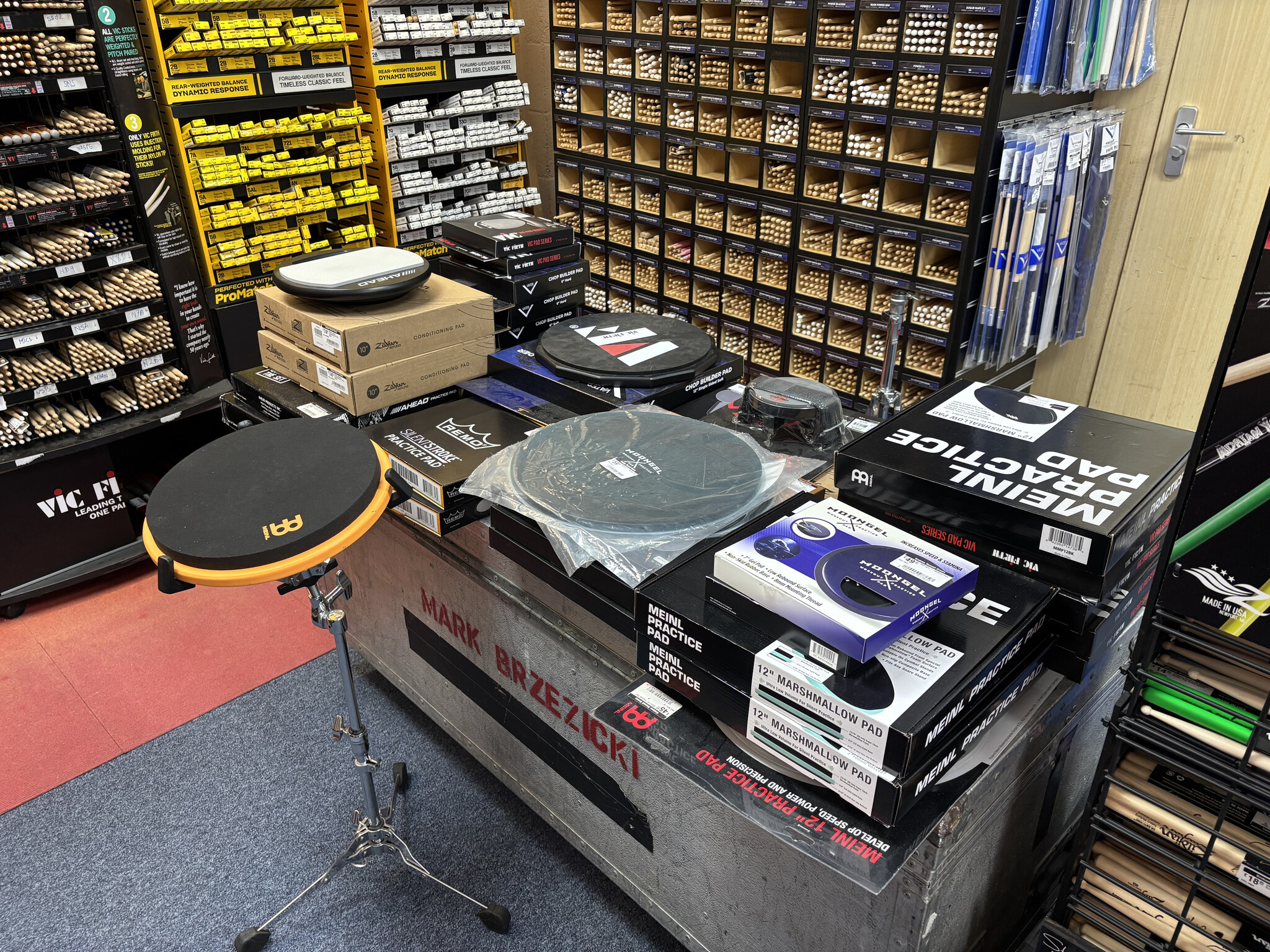
What is a drum practice pad for?
A practice pad gives you somewhere much quieter and more convenient than an acoustic drum to work on your hands when a kit is unavailable or would be too loud. Its main purpose is to let you repeat the fundamental movements used in drumming, then translate that improved control back onto the kit.
For example, a drummer can learn single strokes, double strokes and paradiddles slowly on a pad, develop the timing and movement until they feel comfortable, and then apply those sticking patterns between the snare drum and toms. Pad practice does not teach every part of playing a kit, but it gives the hands a strong technical foundation.
A practice pad can be used for:
- Single strokes, double strokes, paradiddles, flams and other rudiments
- Timing exercises with a metronome
- Stick control, accents and dynamics
- Speed, endurance and coordination
- Developing weaker-hand control
- Warming up before rehearsals, recording sessions and gigs
- Maintaining technique while travelling or away from a drum kit
- Quiet practice at home
A pad is extremely useful, but it should complement time spent on a drum kit rather than replace it completely. A snare drum responds differently, produces a much wider dynamic range and lets you hear whether your strokes are creating the sound you actually want. The aim is to develop movements on the pad and then make sure they work musically around a real kit.
Is a bouncier practice pad better?
Rubber is the usual go-to practice-pad surface because it is durable, reasonably quiet and gives a clear response. It is also extremely bouncy. On many rubber pads, the stick returns faster and more easily than it would from a normal acoustic drum.
That can be useful. A responsive surface helps beginners understand rebound and lets experienced players work on finger control, doubles and faster patterns. However, it can also do some of the work for you. Something that feels effortless on a highly responsive pad may be more difficult when transferred to a snare drum or tom.
This is why softer pads can be such useful technique tools. A Meinl Marshmallow, Zildjian Reflexx or soft Vater Chop Builder gives less of the stroke back to you. Instead of simply being easier because the rebound is fast, the exercise becomes harder than it would be on many acoustic drums. Your hands have to lift and control the sticks more deliberately, which can help develop control, strength and endurance.

The best approach is not to use the deadest surface you can find for every practice session. Use a softer pad for focused conditioning, then transfer the same exercise to an ordinary rubber pad and an acoustic drum. That helps make sure the extra work is improving your playing rather than encouraging you to grip more tightly or force the stroke.
Understanding the different practice-pad surfaces
| Surface | Feel and rebound | Best suited to |
|---|---|---|
| Hard rubber | Fast, firm and articulate | Budget pads, clear sticking definition and players who prefer a harder response |
| Standard rubber | Responsive, controlled and familiar | Everyday practice, beginners and general rudiment work |
| Soft rubber | Less rebound and more resistance | Conditioning, endurance and more deliberate stroke control |
| Thick foam | Quiet with substantially reduced rebound | Low-volume practice and technique conditioning |
| Gel | Very little assistance from the surface | Short, focused strength and endurance exercises |
| Mesh or drumhead-style material | Springy and more like a tensioned head | Players who want adjustable or more drum-like response |
| Textured brush surface | Allows the wires to sweep across the pad | Brush patterns and jazz technique |
| Dual-sided pad | Two contrasting responses in one pad | Drummers who want general practice and conditioning from one product |
No surface is best at everything. A responsive rubber pad and a lower-rebound pad make a particularly useful pair because they train different parts of the stroke.
Our best all-round practice pads
For most drummers, the middle ground is a standard rubber pad. The rubber on pads from Vic Firth, Meinl and Vater generally feels slightly softer and more forgiving than the harder surface used on the budget Stagg option. They still offer plenty of rebound, but they are comfortable for everyday rudiments, warm-ups and technique work.
Good all-round choices include:
- Vic Firth 6" Practice Pad or Vic Firth 12" Practice Pad
- Meinl 6" Practice Pad or Meinl 12" Practice Pad
- Vater 6" Soft Chop Builder, Vater 6" Hard Chop Builder or Vater 12" Two-Sided Chop Builder
- Evans 12" RealFeel Single-Sided Pad or Evans 12" RealFeel Two-Sided Pad
If you are buying your first pad and do not yet know which response you prefer, this is the safest part of the range to start with.
The cheapest conventional practice pad
The Stagg is our least expensive conventional practice pad, and it will do the job perfectly well for a beginner. You do not need a more expensive pad to start learning rudiments, improving your timing or developing basic hand technique.
The 8" version is compact and inexpensive, while the 12" version gives you a larger, more snare-like target and includes an 8mm threaded mounting insert. In either case, it can simply be placed on a table and used without buying a stand.
The compromise is the playing surface. Stagg uses a relatively hard rubber that feels firmer and faster than the slightly softer rubber found on the Vic Firth, Meinl and Vater alternatives. It does the job and makes a sensible low-cost first pad, but somebody planning to practise regularly may prefer the feel of one of the middle-ground options.
The Tama Traveller 4" Practice Pads cost less, but these are tiny portable warm-up pads rather than direct replacements for a normal 8", 10" or 12" practice pad.
The quietest practice pads we recommend
No practice pad is completely silent. You will always hear the stick striking the surface, and some vibration can travel through a desk or floor. However, the Meinl Marshmallow and Zildjian Reflexx are two of the strongest options in our range when low volume is the priority.
Meinl Marshmallow Practice Pads
The Meinl Marshmallow uses a thick foam playing surface that keeps the volume very low while providing much less assistance than an ordinary rubber pad. It is a strong choice for home practice, flats, late-night sessions and drummers who want to combine quiet playing with conditioning work.
It is available in two main sizes. The 6" pad is easy to carry, while the 12" pad gives you a more comfortable home-practice target and can sit in a snare stand. Each pad also has an 8mm threaded insert for a compatible stand.
Zildjian Reflexx Conditioning Pads
The Zildjian Reflexx is a dual-sided conditioning pad. Its Flexx side supplies a moderate amount of resistance and rebound, while the Workk side is firmer and gives less rebound. This lets you change the difficulty without changing pads, and makes the Reflexx particularly useful for working on arm, wrist and finger control at different stroke heights and speeds.
The Reflexx is offered in 6" and 10" sizes. Both are available in black, green and blue:
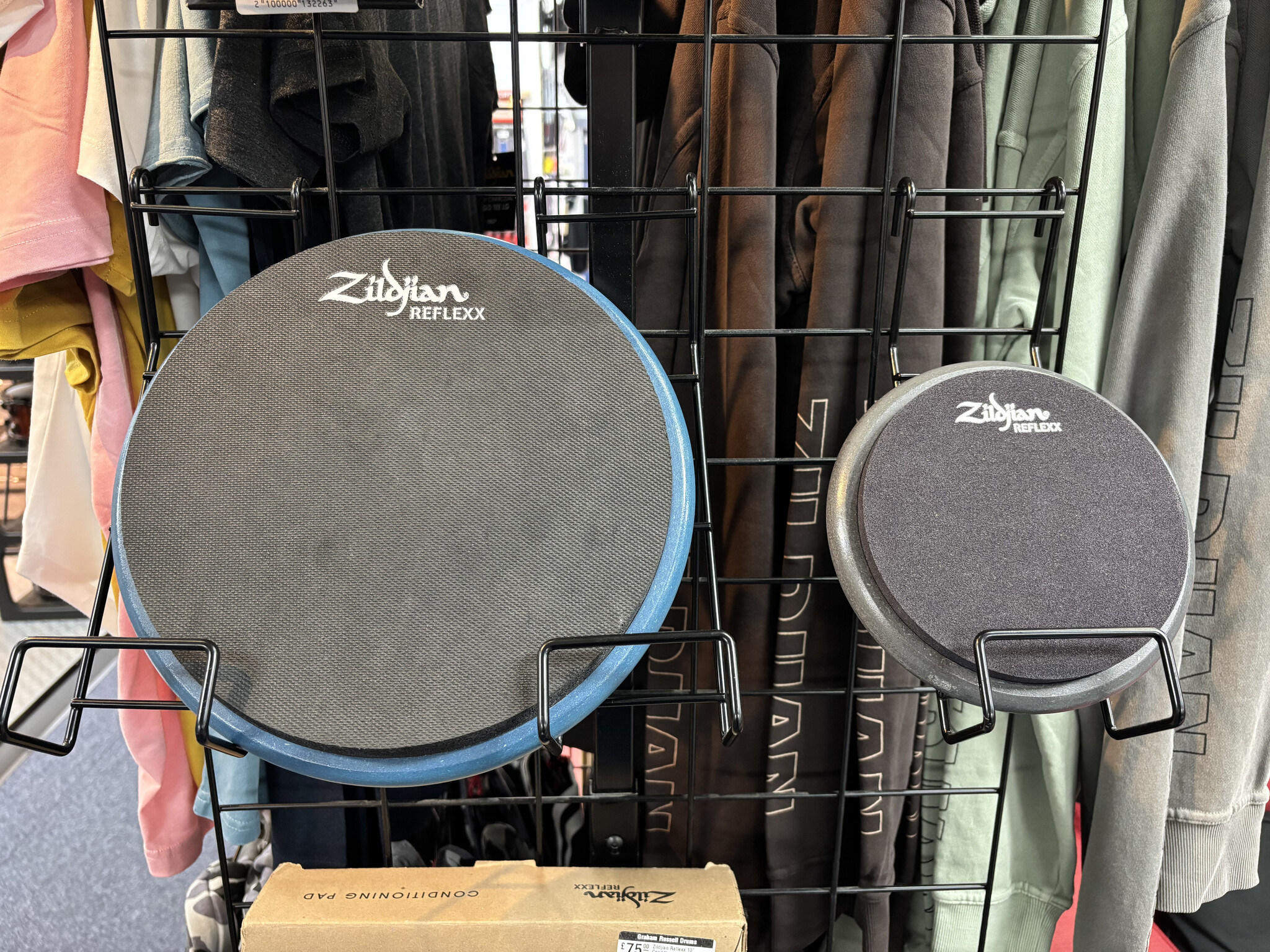
Pictured: Blue 10" Zildjian Reflexx Conditioning Pad and Black 6" Zildjian Reflexx Conditioning Pad.
The Meinl is the simpler quiet option. The Zildjian costs more, but its two surfaces give you a more complete conditioning tool.
What size practice pad should you choose?
| Size | Best suited to | Main consideration |
|---|---|---|
| 4" to 6" | Travelling, backstage warm-ups and accuracy exercises | Extremely portable, but provides a small target |
| 8" to 10" | General practice with easier portability | A useful balance between playing area and size |
| 12" to 14" | Home practice, snare-stand use and brush work | More comfortable and drum-like, but less convenient to carry |
A 10" or 12" pad is usually the easiest recommendation for a beginner practising at home. The larger target lets you concentrate on the stroke without every small placement error sending the stick off the edge.
A 6" pad is better when portability matters. The smaller target can also be useful for accuracy, although it does not make the pad technically more advanced. A compact pad only helps accuracy if you continue to play with a relaxed, natural motion.
How to set up a drum practice pad
You probably do not need to buy a stand. Most people simply place their practice pad on a table or desk, especially when they are starting out. The other mounting methods are useful when you want a particular playing height, practise while travelling or have no suitable flat surface.
If you do want to mount it, choose the pad around the setup you intend to use. These are the main mounting types in our current range:
| Setup | Exact examples from our range | What to know |
|---|---|---|
| Loose on a table, desk, drum or lap | Stagg 8" Practice Pad, Tama Traveller 4" Practice Pad, Zildjian Reflexx 6" and 10" pads, the Evans and Vic Firth double-sided pads, Vater Chop Builder Zero and Tackle Coffee Table Pad | These do not need a stand. Put the pad on a stable surface at a comfortable height. This is how most beginners use a pad. |
| 8mm threaded cymbal stand or practice-pad stand | Stagg 12"; Vic Firth 6"; the Meinl 6", Meinl 12" and 6" or 12" Meinl Marshmallow pads; the single-sided Evans RealFeel 6", Evans Apprentice 7" and Evans Attacktile 10"; Vater 6" Soft and Vater 6" Hard Chop Builder; and the Ahead 7" and Ahead 10" Mounted Pads | Remove the cymbal wingnut and felts, then screw the pad gently onto the 8mm post. Do not force it if the threads do not engage cleanly. |
| Snare drum stand | Conventional 12" pads including the Meinl 12", Vic Firth 12", Evans RealFeel 12" and Vater 12" Chop Builder, plus larger specialist pads such as the Ahead 14" Brush Pad | A snare basket is usually the most drum-like setup. The stand must close far enough to support the pad, so very small 4" and 6" pads are generally unsuitable. |
| Leg strap | Ahead Strap-On Practice Pad and Gibraltar Leg Practice Pad | These fasten above the knee and need no stand or table, making them especially useful backstage and while travelling. |
| Product-specific mounting system | Ahead Compact 6" Stick-On Pad, RTOM Black Hole and Tama True Touch 8.5" Pad | The Ahead uses a washable tacky backing on a clean flat surface, the RTOM snaps onto an acoustic drum and the Tama is supplied with its own mounting clamp. |
The exception worth remembering is the Remo 8" Silentstroke. Remo tunable practice pads use a 1/4"-20 thread rather than the usual 8mm cymbal-stand thread, so an adaptor is required before mounting one on a normal modern cymbal stand.
On a table or desk
Many pads have a rubber, foam or non-slip base and can sit directly on a stable table. This is the simplest and most common setup, and it is absolutely fine for everyday practice. Just make sure the surface is at a sensible height. If the desk forces you to lift your shoulders, bend your wrists sharply or lean forward, the position is working against the technique you are trying to improve.
Putting a folded towel or isolation mat underneath can reduce vibration travelling through the furniture, although it may also make the pad feel slightly less stable.
In a snare drum stand
Larger 10", 12" and 14" pads can often sit in a standard snare stand basket. This is one of the best ways to reproduce your normal playing height and angle.
Open the basket far enough to support the pad, place it centrally and tighten the stand only until the pad is secure. There is no need to clamp the basket hard against the edge. Not every small pad will be wide enough for every snare stand, so check the size before relying on this method.
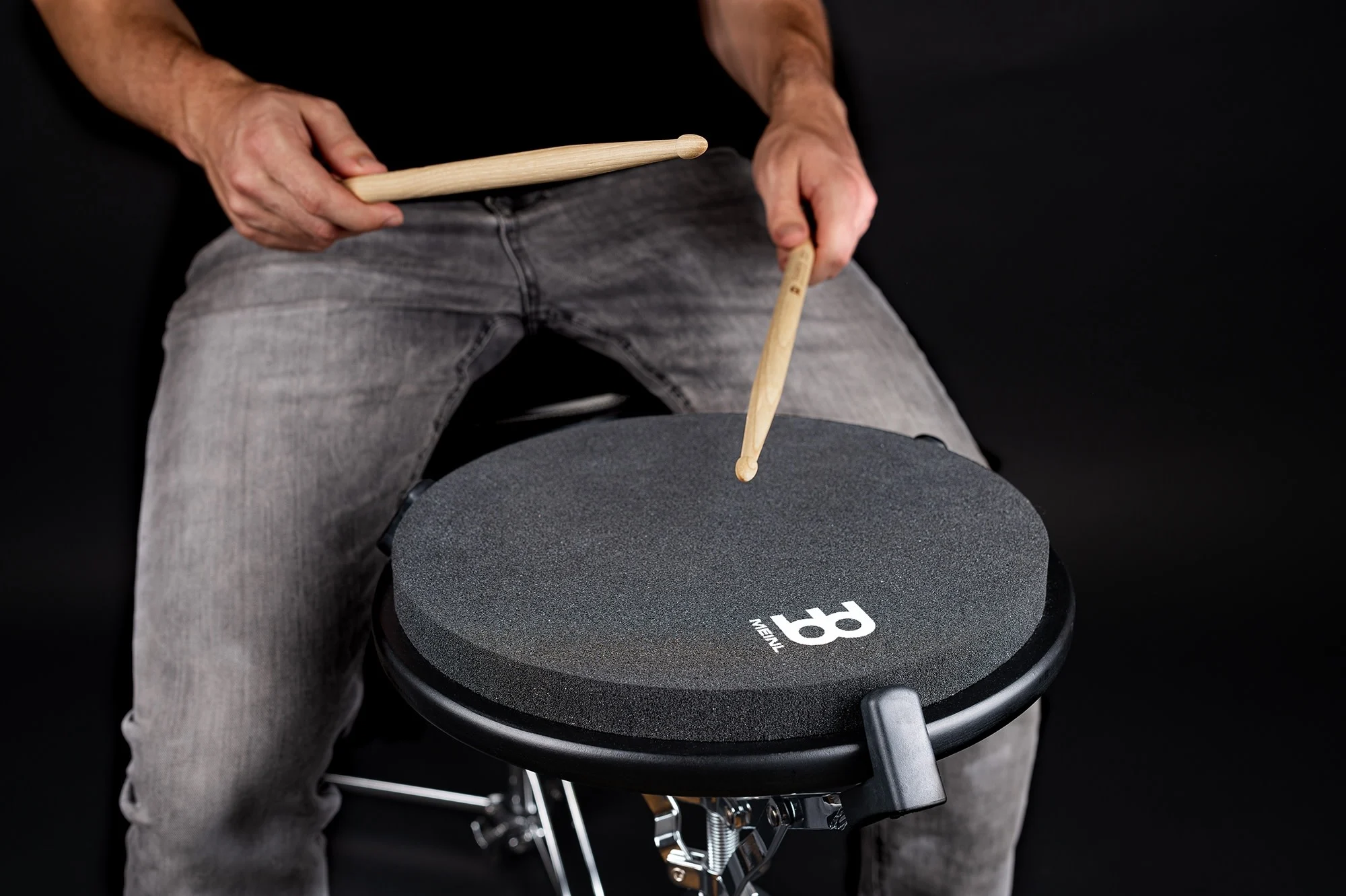
On a cymbal stand or practice-pad stand
Many compact pads have an 8mm threaded insert underneath. This screws onto the threaded top of a compatible cymbal stand, boom arm or dedicated practice-pad stand.
- Remove the cymbal wingnut, sleeve and felts if necessary.
- Confirm that the pad and stand use compatible threads.
- Place the stand upright and screw the pad on gently by hand.
- Stop when the pad is secure. Do not force it or risk cross-threading the insert.
- Adjust the height and angle before you begin playing.
An 8mm insert is common, but it is not universal. Some Remo tunable pads use a different thread and require the correct stand or an adaptor. Never force a pad onto a stand just because the threads look similar.
On your lap or strapped to your leg
A compact pad can rest on your lap for a quick warm-up, although it may move around and will usually sit lower than your normal snare position.
For a more secure stand-free setup, the Ahead Strap-On Practice Pad and Gibraltar Leg Practice Pad fasten above the knee. They are useful backstage or while travelling because you do not need a table or stand. Fasten the strap firmly enough to hold the pad without restricting circulation.
Setting up a bass drum practice pad
A bass drum practice pad sits on the floor and accepts a normal bass drum pedal. Clamp the pedal to the pad's base in the same way you would attach it to a bass drum hoop, then adjust the beater angle and spring tension to your usual settings.
Choose a stable, non-slip floor and position the pad so that your knee and ankle sit naturally. If you use a double pedal, confirm that the pad is wide enough for both beaters before buying.
Single-sided or double-sided practice pad?
A single-sided pad is usually lighter, simpler and less expensive. It is all most beginners need when the main aim is to practise rudiments consistently.
A double-sided pad gives you two responses. One side may provide the familiar bounce of standard rubber, while the other uses harder or softer material for a different workout. This makes the Evans RealFeel Two-Sided, Vater Two-Sided Chop Builder, Ahead Soft and Hard Rubber Pad and RTOM Dual-Surface DBS useful for drummers who want contrasting feels without carrying two pads.
Specialist practice-pad options
Mesh and drum-like pads
The Remo 8" Silentstroke uses a low-volume mesh-style head. The RTOM Black Hole Practice Pad and Tama True Touch 8.5" Practice Pad take the drum-like approach further. The Tama includes a raised rim and a more detailed snare-style response for practising techniques that an ordinary flat rubber pad cannot reproduce as convincingly.
Brush practice
Normal rubber is suitable for stick work but does not let wire brushes sweep in the same way as a coated drumhead. The Ahead 14" Double-Sided Brush Pad gives you a specialist surface for brush patterns while retaining another side for general practice.
Very low-rebound workout pads
The Moongel 14" Workout Pad provides very little free rebound and is a demanding conditioning tool. This sort of pad is best used for controlled portions of a practice session rather than as the only surface you ever play.
Snare-response pads
The Ahead 10" Snare Pad adds a simulated snare response while keeping the overall volume much lower than an acoustic drum. It is useful when hearing the relationship between the stroke and a snare-like sound matters more than absolute quietness.
Full-kit and foot practice
Hand pads cannot develop the movement and coordination required around a drum kit. The DW Go Anywhere Practice Kit provides several pads in a compact kit-style layout, while the Tama True Touch Practice Kit offers a more detailed multi-pad practice system.
For foot technique, use a dedicated bass drum pad such as the Evans Folding Bass Pedal Practice Pad or DW Steve Smith Bass Drum Practice Stand.
Which practice pad should a beginner buy?
For a beginner, the honest answer is that the cheapest conventional pad will do the job. Place it on a table and it gives you everything you need to begin learning single strokes, double strokes, paradiddles and the other main rudiments. You do not need a specialist surface or a separate stand to get started.
If the budget allows and you expect to use it regularly, a 10" or 12" standard rubber pad such as the Vic Firth 12" Practice Pad, Meinl 12" Practice Pad, Vater 12" Two-Sided Chop Builder or Evans 12" RealFeel gives a slightly softer middle-ground feel and a comfortable target. It is a nicer option, but it is not a requirement for learning.
Choose the Stagg 8" Rubber Practice Pad if keeping the cost down is the main priority and you do not mind a harder rubber surface. Choose a compact Vic Firth 6" Practice Pad if it needs to live in a school bag or stick bag. Choose a Meinl Marshmallow or Zildjian Reflexx if quietness matters more than having a conventional rubber response, or if you specifically want a lower-rebound conditioning surface.
If possible, alternate pad practice with a real snare drum. The pad helps you repeat movements quietly and consistently; the drum tells you what those movements actually sound like.
Frequently Asked Questions
Which practice pad is best for a beginner?
The Stagg 8" Rubber Practice Pad is our simplest value recommendation and will do the job for learning rudiments and basic hand technique. If you want a larger target and slightly softer rubber, consider the Vic Firth 12" Practice Pad, Meinl 12" Practice Pad, Vater 12" Two-Sided Chop Builder or Evans 12" RealFeel. You can place any of these on a stable table, so a beginner does not need to buy a stand.
Are drum practice pads completely silent?
No. Every pad produces some stick-impact noise, and a pad placed on a desk can transfer vibration through the furniture. The Meinl Marshmallow and Zildjian Reflexx Conditioning Pad are our strongest recommendations when quietness is the priority. A towel or isolation layer can also help reduce vibration beneath a tabletop pad.
Do I need a stand for a practice pad?
Not necessarily. Most people simply put a pad such as the Stagg 8" on a stable table and do not mount it. A stand is worthwhile when you want the pad at the same height and angle as your snare drum, or when no suitable surface is available. A 12" pad such as the Meinl 12" can sit in a snare stand, while the Meinl 6" can screw onto a compatible 8mm stand.
Can I put a practice pad in a snare drum stand?
What is the screw hole underneath a practice pad for?
It is a threaded mounting insert. Pads including the Stagg 12", Meinl 6", Meinl 12", Evans RealFeel 6" and Vater 6" Chop Builders use an 8mm insert that screws onto a compatible cymbal stand or practice-pad stand. Not every pad uses the same thread: the Remo 8" Silentstroke requires an adaptor for a standard modern 8mm cymbal stand.
Is a hard or soft practice pad better?
Neither is universally better. The budget Stagg 8" has a harder, faster rubber surface, while standard pads from Vic Firth, Meinl, Vater and Evans are our preferred middle ground for everyday practice. Softer options such as the Meinl Marshmallow and Zildjian Reflexx are quieter and make your hands generate more of the stroke, which is useful for conditioning and control.
Are low-rebound pads good for technique?
They can be extremely useful when used deliberately. The Meinl Marshmallow, Zildjian Reflexx and Vater 6" Soft Chop Builder expose strokes that rely too heavily on bounce and can help develop control and endurance. Do not force the stick or tighten your grip to compensate, and regularly transfer the exercise back to a normal pad and acoustic drum.
Is a double-sided practice pad worth buying?
Yes, if you will genuinely use both surfaces. Options such as the Evans 12" RealFeel Two-Sided Pad, Vater 12" Two-Sided Chop Builder and Ahead 10" Soft and Hard Rubber Pad give you two different responses without carrying two pads. If you only want a straightforward place to practise rudiments, a single-sided rubber pad is usually enough.
Can I use ordinary drumsticks on a practice pad?
Yes. Standard wood-tip or nylon-tip drumsticks are suitable for normal practice pads. Very hard surfaces may show wear more quickly on heavily used wood tips, so check your sticks for chips before using them on acoustic heads or cymbals.
Can I use brushes on a rubber practice pad?
You can tap with brushes on rubber, but it will not reproduce a natural sweep. We recommend the Ahead 14" Double-Sided Brush Pad if you want to practise circular motions and continuous brush patterns on a suitable textured surface.
Can you learn drums using only a practice pad?
A pad is enough to begin learning grip, timing, rudiments and hand coordination. It cannot teach movement around the kit, foot technique, balance between limbs or how to control the sound of real drums and cymbals. For a kit-shaped practice setup, consider the DW Go Anywhere Practice Kit or Tama True Touch Practice Kit. For foot technique, use a dedicated option such as the Evans Folding Bass Pedal Practice Pad.
What should a beginner practise first?
Start with relaxed full strokes, alternating single strokes and slow double strokes with a metronome. Aim for an even sound and consistent stick height before increasing the speed. Good technique at a manageable tempo is more useful than playing quickly with tension.
Final thoughts
The best practice pad is the one that suits the job you actually need it to do. For a first pad, a standard rubber model such as the Vic Firth 12" Practice Pad, Meinl 12" Practice Pad, Vater 12" Two-Sided Chop Builder or Evans 12" RealFeel is the safest middle ground. The Stagg 8" Rubber Practice Pad is the value choice if you are happy with a harder surface. For quiet practice and more demanding technique work, the Meinl Marshmallow and Zildjian Reflexx Conditioning Pad are our strongest recommendations.
Many experienced drummers will get more from owning two different surfaces than from searching for one pad that does everything. Use the responsive pad to work with rebound, use the softer pad to make the hands work, and keep checking both against an acoustic drum.
Written by Joel Smith
I have been part of Graham Russell Drums since I was 15 in 2019 and now work here full-time. Starting on the shop floor, I have built and tuned hundreds and hundreds of drum kits across every price point and playing style, advised everyone from families buying a first kit to international touring drummers, and had my knowledge sharpened further by years of in-store clinics and masterclasses with some of the world's finest players. The advice here comes from that experience, not a spec sheet.












Comments
Be the first to comment...