


Graham Russell Drums' Favourite Snare Drum Heads: Evans and Remo Compared
- Posted on
- By Joel
- Posted in Snare heads
- 0
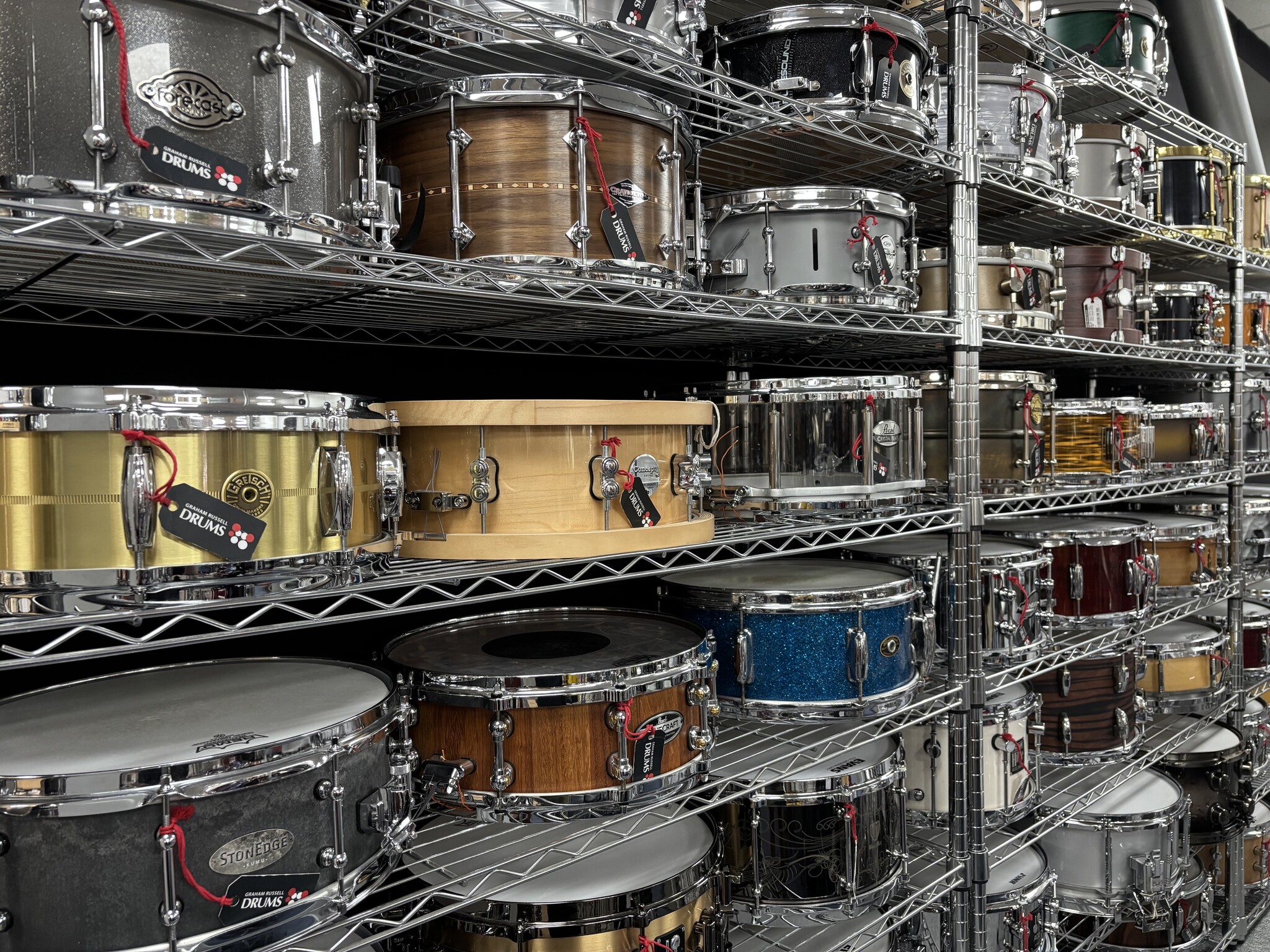
Not sure which snare drum head to choose? We compare the Evans and Remo heads we use, stock and recommend at Graham Russell Drums, explaining how each option changes the sound, response and control of your snare.
Graham Russell Drums’ Favourite Snare Drum Heads: Evans and Remo Compared
Changing your snare drum head is one of the quickest ways to alter its sound, but choosing the right one is not simply a question of finding the most expensive, thickest or most heavily controlled option.
A simple single-ply coated head allows more of the snare drum itself to come through. You hear more of the shell, hoops, tuning and natural overtones because the head is doing less to shape or control the finished note.
Move towards a thicker or more heavily dampened head and the balance begins to change. The head takes greater control of the sound, reducing more of the drum’s natural ring and producing a shorter, more focused result of its own.
Neither approach is automatically better. It depends on whether you want to hear the character of the drum or make that character easier to control.
These are some of the snare drum heads we use and recommend most often at Graham Russell Drums.
Our Starting Point: The Remo Ambassador Coated
The Remo GRD 14" Ambassador Coated Drum Head is our standard starting point.
We fit Graham Russell Drums branded Coated Ambassadors to our snares because they are simple, versatile and allow us to hear what each drum actually does. It is a single ply of 10mil coated film with no built-in control ring, additional damping or reinforcement dot. That makes it open, responsive and suitable for almost any conventional snare drum.
It is not trying to manufacture a particular snare sound for you. The drum does more of the work.
That matters when we are preparing and evaluating snares in the shop. If we put a heavily controlled head on everything, it becomes harder to hear the differences between the drums themselves. A straightforward Ambassador lets the shell material, depth, bearing edges, hoops and tuning speak more clearly.
For most drummers, it is also all the snare head they really need. It tunes across a wide range, works with sticks and brushes, responds well at quieter volumes and still produces a strong backbeat when played properly.
What Does an Ambassador Coated Sound Like?
- Open and lively
- Clear attack
- Natural sustain and overtones
- Sensitive at lower volumes
- Versatile across different tunings and styles
- Particularly good when you already like the sound of your snare
The Evans 14" G1 Coated Drum Head occupies a very similar position in the Evans range. It is also made from a single ply of 10mil coated film and is designed to produce an open, expressive sound with plenty of sensitivity and sustain.
The Ambassador and G1 are not identical in feel, coating or character, but they serve essentially the same purpose. Both are excellent choices when you want a straightforward all-round snare head rather than one with lots of control already built in.
The Middle Ground: Controlled Sound and Power Center Reverse Dot
A standard single-ply head gives you the most open starting point, but some players want slightly more focus, durability and weight through the centre of the drum.
That is where the Remo 14" Controlled Sound Coated Drum Head and Evans 14" Power Center Reverse Dot Snare Drum Head come in.
Both are based around a single ply of 10mil coated film with an additional 5mil dot underneath the centre. The outer area is still able to move relatively freely, while the centre dot gives harder strokes more focus and increases durability.
They sit between the open character of an Ambassador or G1 and the much more controlled sound of an HD Dry or Powerstroke 77.
Remo Controlled Sound Coated
The Controlled Sound gives you the familiar feel and response of a single-ply coated head, but with a slightly more focused centre note.
The reverse dot adds durability and controls some of the overtone when you strike through the middle, while the uncovered outer area retains sensitivity and a reasonable amount of openness.
It is a particularly sensible option when an Ambassador feels slightly too open, but you do not want to lose the personality of the drum.
Evans Power Center Reverse Dot
The Evans Power Center Reverse Dot is Graham’s preferred snare drum head.
Like the Controlled Sound, it uses a 10mil single ply with a 5mil reinforcement patch underneath. Evans cuts slots into its reverse dot so the centre can flex more freely, helping the head retain a relatively open and resonant response despite the additional reinforcement.
It gives the centre of the drum a solid, full-bodied backbeat with good rebound and added durability, but it does not control the snare as aggressively as an HD Dry.
What Is the Difference?
The two heads are closely related and occupy the same general part of the market.
The Remo Controlled Sound tends towards a focused, slightly more direct centre note. The slotted dot on the Evans Power Center is designed to retain a little more movement and openness.
The difference is not enormous. Both make excellent middle-ground choices for somebody who wants:
- More focus than an Ambassador or G1
- Better durability under the centre of the head
- A stronger and weightier backbeat
- Less unwanted ring without heavily dampening the drum
- Plenty of the original snare character left intact
Evans HD Dry: Instant Control
The Evans 14" Genera HD Dry Drum Head is one of the most popular snare drum heads we sell, and it is easy to understand why.
It uses two plies, a built-in overtone control ring and small dry vents around the edge. These features reduce overtones and shorten the sustain before you have added any external damping.
This makes the HD Dry ideal when you want to put a head on a drum and be much closer to a controlled, usable sound immediately.
On a lively steel or brass snare with more ring than you want, it can solve the problem very quickly. It is also useful on stage and in recording situations where you need the note to remain short, focused and predictable.
What Does an HD Dry Sound Like?
- Short and focused
- Reduced high-frequency ring
- Strong, controlled attack
- More compressed than a single-ply head
- Durable enough for regular harder playing
- Easy to manage without adding lots of external damping
The HD Dry is not necessarily the right answer for every drum. Put one on a snare that is already naturally dry and you may remove too much of its character.
It works best when you actively want the head to control the drum rather than simply allowing the drum to speak.
Remo Powerstroke 77: Maximum Weight and Control
The Remo 14" Powerstroke 77 Coated Drum Head moves even further towards a sound created and controlled by the head itself.
It is constructed from two plies of 7mil coated film, with a 7mil inlay ring and a 5mil clear dot on top. That is a considerable amount of material compared with an Ambassador, G1 or Diplomat. It is designed to reduce overtones, increase durability and produce a powerful, focused attack.
The result is thick, controlled and substantial. The Powerstroke 77 works well for heavy backbeats, louder live playing and drummers who want a consistent sound without having to spend as much time controlling the drum afterwards.
What Does a Powerstroke 77 Sound Like?
- Thick and powerful
- Strong centre attack
- Very controlled overtones
- Shorter and denser than a single-ply head
- Highly durable
- Less revealing of the drum’s natural openness
An HD Dry and a Powerstroke 77 both provide significant control, but they achieve it differently.
The HD Dry uses its control ring and perimeter vents to reduce ring and sustain. The Powerstroke 77 uses its heavier two-ply construction, inlay ring and reinforcement dot to create a dense, powerful and physically substantial response.
Both are useful when you do not particularly want to hear every overtone the snare naturally produces.
Remo Diplomat Coated: Hear More of the Drum
The Remo 14" Diplomat Coated Drum Head takes us in the opposite direction.
Rather than adding material and control, the Diplomat uses a thinner single ply of 7.5mil coated film. This allows it to move more freely and respond particularly well to lighter playing, quieter dynamics and higher tunings.
The Diplomat is the option here that lets you hear the most from the drum.
Its thinner film reveals more of the shell, tuning, overtones and snare response. It can make a drum feel extremely lively and sensitive, particularly when tuned carefully.
That openness also means it is less forgiving. A poorly tuned drum, uneven bearing edge or unpleasant overtone will not be hidden by the head. It gives you more of everything, including the parts of the drum you may be trying to control.
What Does a Diplomat Coated Sound Like?
- Very open and sensitive
- Bright, quick response
- More audible shell character and overtone
- Excellent at lower dynamics
- Particularly responsive at medium and higher tunings
- Less durable for consistently heavy playing
Most players instinctively move towards a thicker head when they want to change a snare sound. The Diplomat is worth considering when the drum feels too restrained, thick or unwilling to open up.
Warmer and More Traditional Sounds: Calftone and Fiberskyn
Not every head choice is simply about adding or removing overtone control.
The Evans 14" Calftone Tom Drum Head and Remo 14" Fiberskyn 3 Ambassador Drum Head provide warmer, more traditional alternatives to conventional coated heads.
The Evans Calftone uses a 7mil film base blended with additional materials. It is thinner and more responsive than Evans’ Calftone bass drum heads, helping it work at higher tunings and on smaller drums.
The Ambassador Fiberskyn combines a 10mil film with a polyspun fibre layer, producing a warmer attack with greater emphasis on the middle and lower frequencies.
These are useful when you want:
- A warmer and softer attack
- More texture under sticks and brushes
- A traditional visual appearance
- Less of the sharp, modern attack associated with a conventional coated plastic head
- A different character rather than simply more damping
They are particularly at home on vintage-style drums, orchestral and concert snares, brush setups and instruments where a warmer, rounder response is more important than maximum projection.
Do Not Forget the Snare-Side Head
The head underneath the drum is just as important as the batter head, although it performs a very different job.
A snare-side head is extremely thin and is designed to transfer the movement of the bottom head to the snare wires. It affects wire sensitivity, ghost notes, lower-volume response and the overall crispness of the snare sound.
It is not a standard clear drum head and should never be treated like one.
At Graham Russell Drums, we generally use either the Remo GRD 14" Ambassador Hazy Snare Side Head or the Evans 14" Hazy 300 Snare Side Drum Head .
We even have our own Graham Russell Drums branded Ambassador Hazy heads, matching the branded Coated Ambassadors we fit on top.
Both the Ambassador Hazy and Evans 300 use a single ply of 3mil film. They occupy the standard all-purpose position in their respective ranges, providing a good balance of sensitivity, body and control across different tunings and playing volumes.
You can go considerably further into thinner and thicker snare-side heads. A thinner head generally increases sensitivity, while a thicker head can add body and withstand greater tension and harder playing.
For most standard drum-kit snares, however, an Ambassador Hazy or Evans 300 is the right place to begin.
Which Snare Drum Head Should You Choose?
Choose a Remo Ambassador Coated or Evans G1 Coated if:
- You want a versatile all-round snare head
- You already like the natural sound of the drum
- You want to hear more of the shell and tuning
- You use a broad range of dynamics and playing styles
- You want a reliable starting point without built-in damping
Choose a Remo Controlled Sound or Evans Power Center Reverse Dot if:
- You want more focus and durability than a standard single-ply head
- You still want the drum to sound open and responsive
- You want a stronger centre backbeat
- You do not want to move to a heavily controlled head
Choose an Evans HD Dry if:
- The drum produces more ring than you want
- You want a short, focused sound quickly
- You would rather avoid adding separate damping products
- You need a controlled live or recording sound
Choose a Remo Powerstroke 77 if:
- You play hard and need excellent durability
- You want a dense and powerful backbeat
- You want the head to suppress more of the drum’s natural overtones
- You prefer a heavily focused, controlled response
Choose a Remo Diplomat Coated if:
- You want maximum sensitivity and openness
- You want to hear as much of the drum itself as possible
- You play at quieter dynamics or use a higher tuning
- The snare currently feels too heavy, dull or restrained
Choose an Evans Calftone or Remo Fiberskyn if:
- You want a warmer, rounder or more traditional character
- You play with brushes
- You want a vintage-inspired appearance and feel
- You want a tonal change rather than simply more overtone control
Still Not Sure?
We keep multiples of these heads in stock at Graham Russell Drums because there is no single correct head for every player or every snare.
You are very welcome to bring your snare drum into our Fareham showroom and ask us what we think. Tell us what you like about it, what you do not like and what you are struggling to achieve.
We can help you choose the right batter and snare-side combination, fit the heads, tune the drum and show you what to listen for when tuning it yourself.
A head can make an enormous difference, but fitting the right one is only part of the process. The final sound comes from the relationship between the head, shell, hoops, wires and tuning. Sometimes the best solution is a different head. Sometimes the drum simply needs to be tuned differently.
Bring it in and we will help you work out which it is.
I have been part of Graham Russell Drums since I was 15 in 2019 and now work here full-time. Starting on the shop floor, I have built and tuned hundreds and hundreds of drum kits across every price point and playing style, advised everyone from families buying a first kit to international touring drummers, and had my knowledge sharpened further by years of in-store clinics and masterclasses with some of the world's finest players. The advice here comes from that experience, not a spec sheet.












Comments
Be the first to comment...