


Drum Cases Explained - Hardcase, Protection Racket and Ahead cases compared!
- Posted on
- By GRD
- Posted in Acessories, Drum Cases
- 0
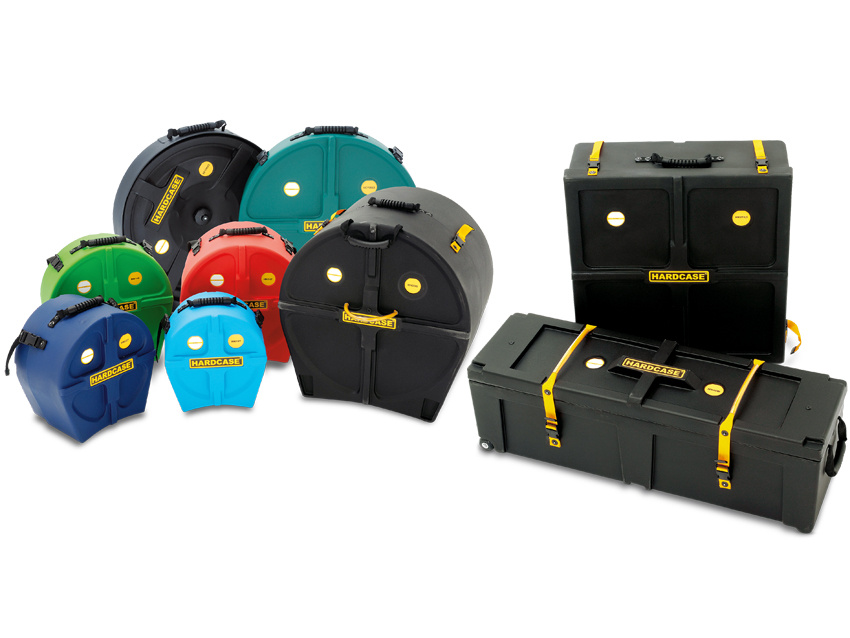
Compare Hardcase, Protection Racket and Ahead drum cases to find the right level of protection for your kit. This guide breaks down hard, padded and semi-rigid options so you can choose with confidence.
Choosing the right drum cases is not simply about buying the strongest option available. The best case depends on how your kit is transported, who handles it, whether the drums are stacked beneath other equipment and how much carrying weight and storage space you can tolerate.
A drummer moving a kit carefully in their own car has very different protection requirements from someone loading drums into a tightly packed van several nights each week. Some cases prioritise crush resistance, while others focus on impact absorption, finish protection and portability.
In this guide, we compare Hardcase, Protection Racket and Ahead Armor, explain the differences between rigid and padded construction, and help you choose the right protection for your drums.
Quick Answer: Which Drum Cases Should You Choose?
- Hardcase Standard: maximum structural and crush protection for regular van loading and stacking.
- Hardcase Fully Lined: rigid protection with additional interior finish care for lacquered or premium kits.
- Protection Racket Nutcase: affordable lightweight protection for storage, lessons and controlled transport.
- Protection Racket ProLine: the strongest all-round padded option for regular gigs and personal-car transport.
- Protection Racket AAA Rigid: framed, shape-retaining protection without using a moulded plastic shell.
- Ahead Armor: shaped padded cases with easy loading, strong impact absorption and room for mounting hardware.
Hardcase Drum Cases: Maximum Structural Protection
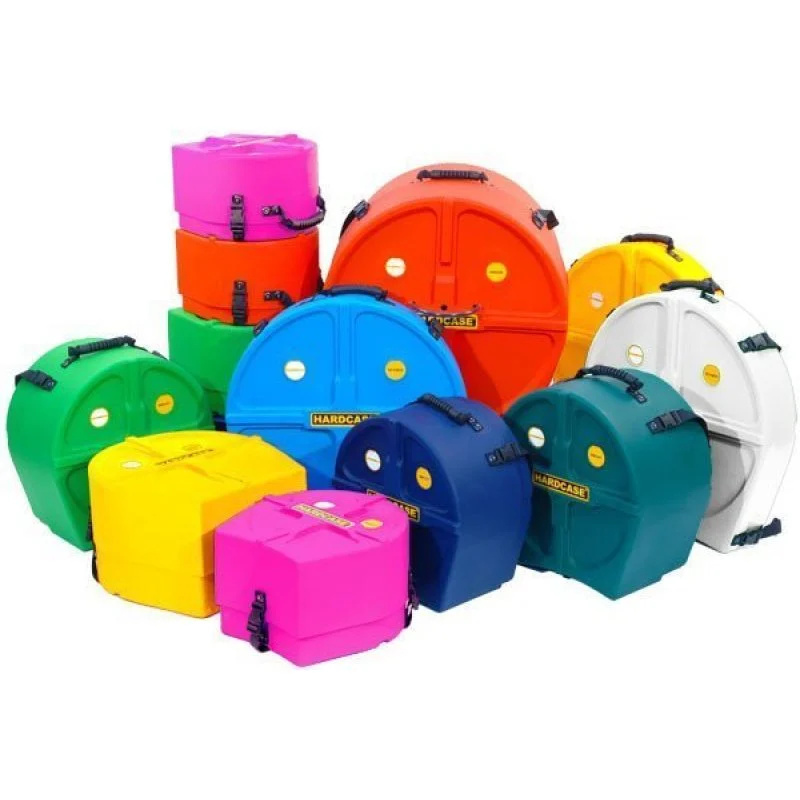
When drums are stacked in vans, strapped beneath hardware or handled by several different people, a rigid shell provides the strongest defence against crushing and deformation. Hardcase cases use moulded plastic construction that retains its shape under pressure, helping protect shells, hoops, bearing edges and fittings from heavy external loads.
This is the main distinction between Hardcase and a padded bag. Foam can absorb an impact, but it cannot prevent another case or a heavy hardware bag from pressing directly onto the drum. A moulded shell creates a physical barrier around the instrument.
Hardcases are particularly useful for touring players, busy function bands, shared vans, storage units and any situation where the drummer cannot control how every item is stacked. Their secure straps, strong handles and stackable shapes also make organised loading easier.
Hardcase Standard
The Hardcase Standard Drum Case Set focuses on rigid external protection and practical transport. The interior is functional rather than plush, making it a strong option for heavily gigged kits, wrapped finishes and drums that are regularly packed tightly with other equipment.
Choose the standard version when crush resistance matters more than having a soft, fully padded interior. It is especially sensible when the drums are likely to be loaded by other people or when the cases will spend a lot of time stacked in a van.
Hardcase Fully Lined
Fully lined Hardcases use the same type of rigid outer shell but add internal foam lining. This improves protection against rubbing, finish abrasion and movement inside the case.
The lined version is particularly worthwhile for high-gloss lacquer finishes, premium kits and drums you want to keep cosmetically clean over many years. It retains the stacking and structural benefits of the rigid case while providing a softer contact surface around the drum.
The Hardcase Trade-Offs
Rigid cases are heavier and bulkier than padded bags. They do not collapse when empty, so a full set requires meaningful storage space at home, backstage or in a vehicle. Carrying several cases up stairs or through a tight venue can also become tiring.
Hardcase describes its products as rigid plastic protective cases, but they should not automatically be treated as custom flight cases or completely sealed containers. They provide excellent impact, stacking and weather protection for normal musical use, but the correct choice still depends on the transport environment.
Protection Racket Drum Cases
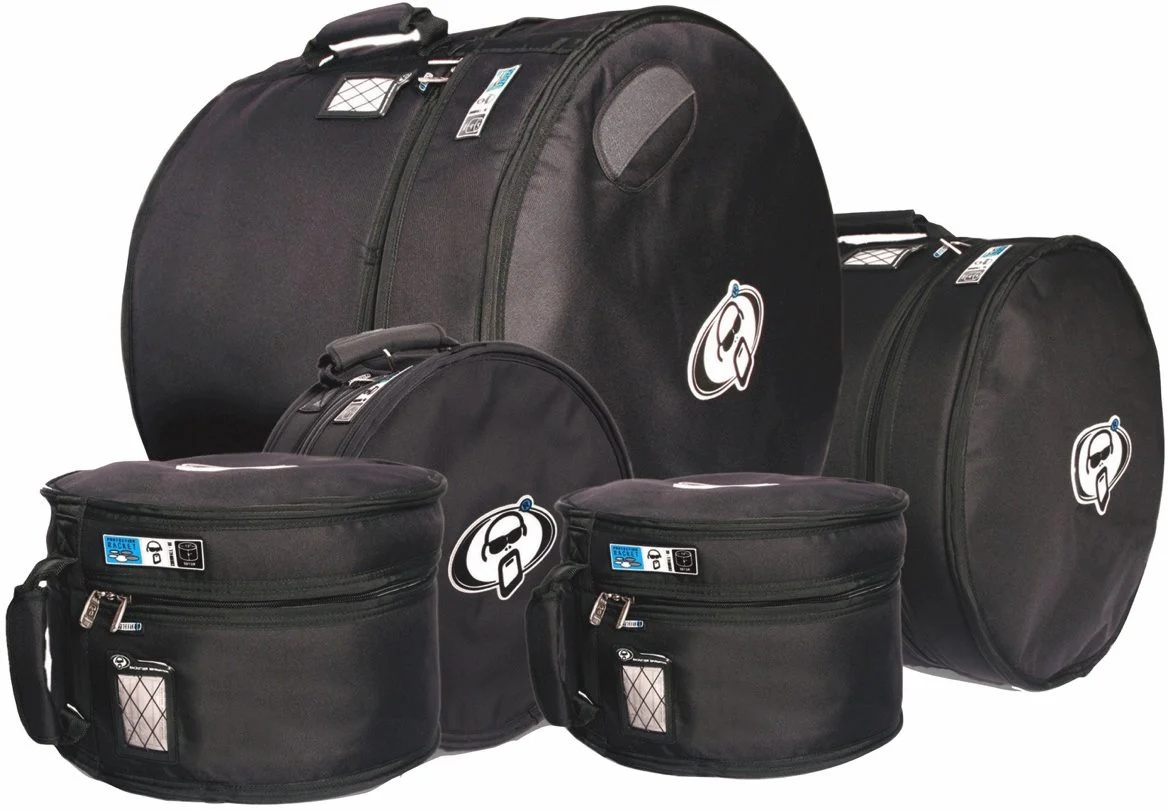
Protection Racket offers more than one type of case construction. Nutcase and ProLine are padded fabric cases, while AAA is officially a rigid case range built around a polycarbonate frame. It is therefore misleading to describe the entire range as different thicknesses of soft bag.
Protection Racket Nutcase
Nutcase is the accessible lightweight option. The cases use a dense foam core and durable fabric construction to protect drums from everyday knocks, scrapes and cosmetic wear without adding much carrying weight.
Nutcase works well for storage, lessons, rehearsal rooms, occasional gigs and controlled car transport. It is a clear improvement over unpadded covers or very basic bags, but it is not intended to provide crush resistance when heavy equipment is stacked on top.
Protection Racket ProLine
ProLine is Protection Racket’s professional padded range and the natural all-round choice for many working drummers. Its layered Propadd foam, Racketex exterior and soft Propile fleece lining absorb impacts while protecting drum finishes from abrasion.
These cases are easy to carry, straightforward to load and far easier to store than rigid moulded cases. For weekly gigging in a personal car—where the drummer controls the loading and the drums are not buried beneath hardware—ProLine often provides the best balance of protection and practicality.
The limitation is structural. ProLine can cushion a drum from a knock or drop, but the case itself remains flexible. It should not be expected to protect a shell from sustained stacking pressure in the same way as a Hardcase or framed AAA case.
Protection Racket AAA Rigid
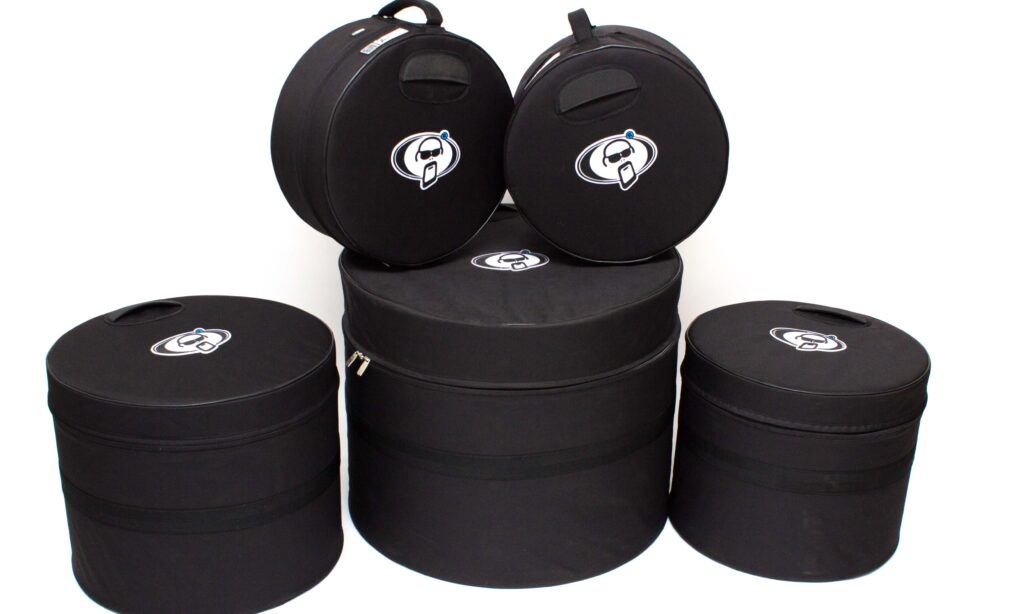
Protection Racket AAA is not simply ProLine with thicker padding. It is a rigid case system using a polycarbonate Triple A-Plex frame inside Protection Racket’s padded and fleece-lined construction.
The frame helps the case retain its shape, increases resistance to crushing and spreads impact around the drum rather than allowing pressure to transfer directly through flexible foam. At the same time, the padded surfaces and fabric exterior retain some of the handling characteristics associated with Protection Racket cases.
AAA therefore sits between ProLine and a moulded Hardcase. It offers much stronger structure than a conventional padded bag, while avoiding the feel and shape of a hard plastic shell. It is well suited to frequent professional transport, busy vans and players who want stronger framed protection without moving fully to Hardcase.
AAA is heavier, more expensive and less collapsible than ProLine, so it will not automatically be the best choice for every drummer. For careful car transport, the extra structure may be unnecessary.
For a more detailed breakdown of sizes and individual models, read our Ultimate Protection Racket Case Buyer’s Guide.
Ahead Armor Drum Cases
Ahead Armor cases are best described as shaped, reinforced padded cases rather than true rigid shells. Their TruForm teardrop design follows the shape of the drum and leaves room for mounting hardware, while the DynaZip opening makes it easier to load and remove the instrument.
The DX-Core construction combines layers of high-impact laminated foam with a Sherpa fleece lining. A weather-resistant 600-denier polyester exterior, reinforced handles and impact protection around vulnerable areas make the cases suitable for regular transport.
The main practical advantage is fit. Conventional round bags can become tight around tom brackets and suspension mounts, whereas the teardrop shape provides additional space where the hardware actually sits. The DynaZip cutaway also reduces the need to force the drum through a narrow circular opening.
Ahead Armor retains its form more effectively than an inexpensive collapsible bag, but it does not use the polycarbonate frame found in Protection Racket AAA or the moulded plastic shell of a Hardcase. Its strength lies in impact absorption, finish protection, shaped fit and convenient access rather than maximum crush resistance.
Hardcase vs Protection Racket vs Ahead Armor: At a Glance
Once the different constructions are understood, the comparison becomes much clearer. The correct choice depends less on the logo and more on whether you need cushioning, shape retention or full structural protection.
| Case range | Construction | Best protection against | Main compromise | Best suited to |
|---|---|---|---|---|
| Hardcase Standard | Rigid moulded plastic | Crushing, stacking and heavy external impacts | Bulk, weight and storage space | Vans, touring and shared transport |
| Hardcase Fully Lined | Rigid shell with foam lining | Crushing plus finish abrasion | Highest bulk and cost | Premium lacquer kits under demanding transport |
| PR Nutcase | Lightweight padded bag | Scrapes and everyday knocks | Limited structure | Storage, lessons and occasional gigs |
| PR ProLine | Professional padded fabric case | Impact and cosmetic wear | No true crush resistance | Regular car transport and weekly gigging |
| PR AAA Rigid | Polycarbonate-framed padded case | Strong impact, shape retention and moderate stacking pressure | More weight and storage space than ProLine | Frequent professional transport |
| Ahead Armor | Shaped multi-layer padded case | Impact, abrasion and protruding fittings | Less crush protection than a rigid shell | Players prioritising fit, access and portability |
How to Measure a Drum for a Case
Drums are normally described by diameter × shell depth. A 14" × 6.5" snare therefore has a nominal 14-inch diameter and a 6.5-inch-deep shell.
To confirm the size, remove uncertainty by measuring the shell itself:
- Measure across the shell from bearing edge to bearing edge to establish the nominal diameter.
- Measure the shell depth between the top and bottom bearing edges.
- Do not include the hoops when identifying the nominal drum size.
- Check for protruding strainers, tom brackets, suspension mounts, floor-tom leg brackets and bass-drum spurs.
- Consult the case manufacturer’s internal dimensions when the drum has unusually large fittings or oversized hoops.
Case manufacturers generally allow extra space beyond the nominal shell size to accommodate hoops and standard hardware. Protection Racket, for example, lists cases by shell size while making the internal dimensions larger for fittings. However, unusual mounting systems may require an egg-shaped, teardrop or deeper model.
Never assume that every drum described as “14-inch” requires the same case. A 14" floor tom, 14" rack tom and 14" snare have different depths and hardware requirements.
Complete Drum-Case Sets vs Individual Cases
A complete drum-case set is normally the simplest and most cost-effective option when the included sizes match the kit. Standard sets commonly cover familiar configurations such as 10", 12" and 16" toms with a 22" bass drum and 14" snare.
Individual cases make more sense when the kit uses unusual sizes, multiple floor toms, a deep snare, a compact bass drum or mixed drums from different kits. They also allow the level of protection to be varied. A drummer might use a rigid bass-drum case because it sits at the bottom of the van, but lighter padded cases for toms carried separately.
Before buying a set, check every diameter and depth rather than relying only on labels such as “fusion” or “rock”. Manufacturers do not always use those descriptions for exactly the same configuration.
Which Drum Cases Should You Choose?
Choose Hardcase when drums are regularly stacked beneath other equipment, loaded into shared vans or handled by people who may not treat them carefully. Choose the fully lined version when preserving a premium finish is also a priority.
Choose Protection Racket ProLine when you carry your own drums in a car and want the strongest balance of impact protection, low weight and compact storage. For many weekly gigging drummers, this is the most practical solution.
Choose Protection Racket AAA when you want a case that retains its shape and provides stronger framed protection, but you do not want a moulded plastic shell.
Choose Ahead Armor when close fit, easy loading and space for protruding tom hardware are particularly important. Its shaped design is a genuine advantage for drums that feel awkward in conventional round bags.
Choose Nutcase when the kit mainly needs protection for storage, lessons, rehearsal rooms and occasional controlled transport.
The right answer may involve more than one brand or construction. Match the case to each drum’s value, finish and position in the vehicle rather than feeling that every case has to be identical.
Frequently Asked Questions
How do I measure a drum for a case?
Measure the shell diameter and shell depth between the bearing edges, without including the hoops. Then check the case specification for additional space around strainers, tom mounts, suspension systems and other fittings.
Are hard drum cases worth the extra weight?
They are worth the extra weight when drums are stacked, transported with heavy equipment or handled by multiple people. When the drummer controls careful car loading and crush pressure is unlikely, a professional padded case may be more convenient.
Are padded drum bags safe for gigging?
Yes. Quality padded cases such as Protection Racket ProLine and Ahead Armor are designed for repeated transport and provide strong impact and finish protection. They are safest when the drums are loaded carefully and not placed beneath heavy equipment.
Are drum cases waterproof?
Many cases use waterproof or highly water-resistant outer materials and will cope with brief rain during load-in. However, zipped bags and strapped rigid cases are not sealed containers and should not be left in prolonged heavy rain or standing water.
Should I buy a complete case set or individual cases?
Buy a set when every included diameter and depth matches the kit. Choose individual cases for unusual configurations, mixed drum sizes or when different drums require different levels of protection.
Written by Alex Neave
I've been part of the Graham Russell Drums team since October 2025, but my connection with the shop goes back much further as a customer since 2012. I've advised drummers of all ages and experience levels, worked on a wide range of second-hand kits and spent a lot of time helping customers navigate the often overwhelming world of drum gear. Alongside over 13 years of playing experience, that hands-on exposure to a wide range of products allows me to write buying guides based on real-world knowledge and practical experience rather than simply repeating manufacturer specifications.












Comments
Be the first to comment...